
Automated AI customer service: how it works when it is connected to your e-commerce (and where a person is still needed)
“Where is my order?”, “Is it available in size 42?”, “Can I change the address?”: most requests reaching an online shop can be solved by reading data the company already has. That is what automated customer service is for, but it only really works if it is connected to your system and if you decide how far it can go. Here is how it is built, what it needs to read and where a person remains essential.
The «info@» inbox that doesn't scale
In many companies that sell online, customer service still works like this: the customer fills in the «contact us» form, the request lands in a mailbox and someone opens it when they can. To answer, they have to look up the customer in the ERP, the order in the e-commerce, the shipment on the courier's website and the stock in the warehouse. Every answer takes four open programs and ten minutes, even when the question is always the same.
Anyone who has run an online shop knows the outcome: response times depend on who reads the mail and when, nobody knows who is handling what, and the good answers written yesterday are of no use tomorrow. In peak periods — Black Friday, Christmas, sales — the inbox overflows exactly when customers are most impatient.
Chatbot or automated customer service?
Many people's first answer is «let's put a chatbot on the website». But a generic chatbot answers with FAQs: it knows that shipping takes «3-5 working days», not that your order left yesterday and is sitting at the Bologna depot. For the most common question of all, «where is my order?», it is useless.
Automated customer service goes one step further: it is connected to the company's systems, reads the real data of each customer and handles the request from start to finish, as an experienced operator would. It is the same difference we described when writing about AI agents for SMEs: from the chatbot that answers to the agent that does the work.
Why it pays off for an SME, and how to keep the human touch at the centre, we covered in AI and customer service for SMEs. Here we get practical: how automated customer service connected to your e-commerce or ERP works, step by step.
How it works, step by step
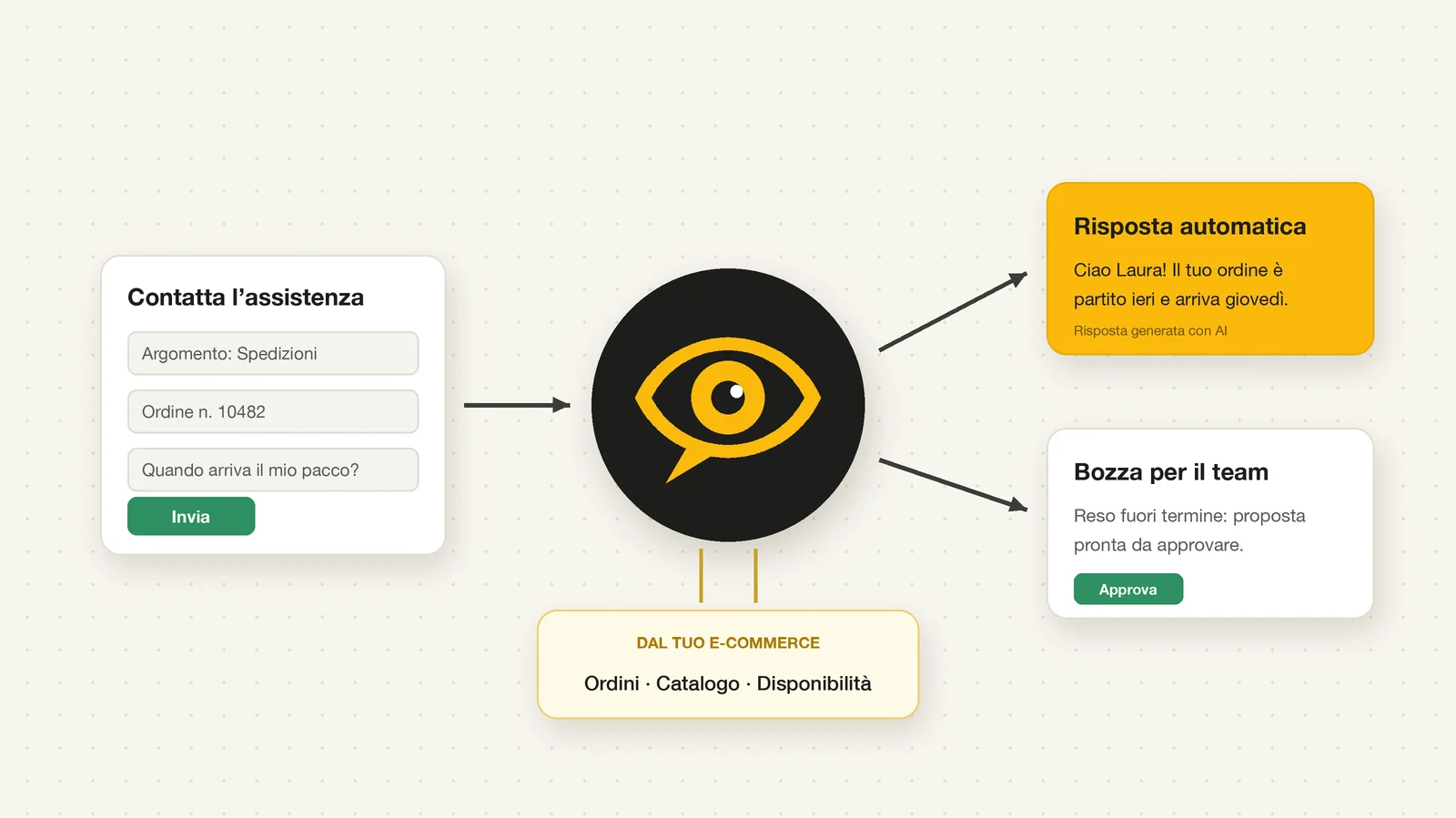
- The request starts on your website. The e-commerce or B2B portal form no longer sends an email: it opens a case in the customer service, with the topic chosen by the customer (shipping, returns, products, invoices…).
- The AI reads it straight away. It detects the language, confirms or corrects the topic, sets the priority and assigns it to the right operator, before anyone even opens the case.
- It checks your system. Through a read-only connector it retrieves customer, order, shipping status, product sheet, price and live availability.
- It verifies who is writing. Before discussing an order it checks that the writer is the account holder, for example with the order number and two details chosen among email, phone and postcode.
- It decides what to do. If information is missing it asks the customer; if the topic is authorised it answers on its own; otherwise it prepares a draft that the operator approves, edits or rewrites.
- The customer replies however they prefer. By email or from a personal case page, without signing up, in their own language.
- It learns from corrections. When an operator corrects a draft, the system suggests what it has learned — a fact, a style rule — and a person decides whether to keep it.
What it needs to read
The value of automated customer service depends almost entirely on the connection. You don't need to rebuild your website or give the AI the keys to your database: a few read-only access points exposed by the e-commerce or ERP are enough:
- the customer: essential details and order history;
- the order: status, items, shipping and tracking;
- the catalogue: product sheets, variants, prices and live availability;
- the company's knowledge: return conditions, shipping times by country, internal procedures, answers already given in solved cases.
Read-only means the AI can tell the customer where the parcel is, but cannot cancel an order or issue a refund on its own. Actions on systems stay with people.
Where a person is still needed
Automating customer service does not mean removing people, but taking them off repetitive work. These stay human, at least at the start:
- sensitive complaints, where tone matters more than information;
- exceptions: the late refund, the discount for a long-standing customer, the return of a customised product;
- actions on systems: cancelling, refunding, changing an address after shipping;
- cases where the AI doesn't know: a good system doesn't make things up, it says so and passes the case to an operator with high priority.
The healthiest rule is to decide autonomy topic by topic: automatic replies for tracking questions, drafts for approval on returns, people only on complaints. You start with everything as drafts and switch to automatic where, week after week, drafts get approved unchanged.
The rules not to skip
Privacy. Order data goes only to those entitled to it, and the identity check must be done by the software, not by the language model: the AI only receives the outcome of the check. Customers' personal data must not end up in the knowledge base the AI consults.
Transparency. Customers must know when an AI is answering them. Since 2 August 2026 this is also an obligation under Article 50 of the AI Act for anyone using systems that interact with people, as we explained in our article on the AI Act. One line at the bottom of the message is enough.
Control and costs. Operators must be able to see why the AI answered the way it did and with which sources, and the company must be able to set a monthly spending cap for the AI, with no surprises on the invoice.
How we built it: A126 Oracolo
These needs gave birth to A126 Oracolo, the automated customer service A126 installs for each company with its own brand and domain. The name comes from the oracles of antiquity, such as the one at Delphi: anyone with a question went there because that is where the answer was.
A126 Oracolo receives requests from your website forms, connects to your e-commerce, B2B portal or ERP through a read-only connector, verifies identity before discussing an order and answers on its own only on the topics you authorise; for everything else it prepares a draft for your team. Customers don't need to sign up, they write and get answers in Italian, English, German or French, and they always know when an AI is answering. When a supplier or courier is needed to answer, the operator forwards the request from A126 Oracolo and the conversation with the third party runs in parallel, without the customer seeing it.
In short
Automated AI customer service is useful when it is connected to the company's systems: e-commerce, B2B portal or ERP. Requests come in from the website forms, the AI labels and assigns them, reads customer, order, shipping and catalogue in read-only mode, verifies that the writer is the account holder and then answers on its own on authorised topics or prepares a draft for operators. People stay on complaints, exceptions and actions on systems, and the AI's autonomy widens topic by topic. Privacy, transparency towards the customer (Article 50 of the AI Act) and a spending cap are starting requirements, not optional extras. A126 Oracolo is built on these principles.
Frequently asked questions
Do I need to rebuild my website or e-commerce?
No. The contact form changes destination and the e-commerce exposes a few read-only access points for customers, orders and catalogue. The rest of the site stays as it is.
How many requests can it handle on its own?
It depends on how repetitive the questions are and how much autonomy you decide to give. Requests about order status, delivery times and availability are the first candidates for automatic replies; the others start as drafts for approval.
What happens if the AI gets it wrong?
On draft topics no message goes out without an operator. On automatic ones the AI answers only with data it reads from your system and, when it isn't sure, hands over. Every operator correction becomes an improvement proposal that the admin approves.
Does the customer need to create an account?
No: they receive answers by email and follow the case from a personal page, reached through the link in the message.
Which languages does it answer in?
In the customer's language. A126 Oracolo's page and emails are in Italian, English, German and French.
At A126 we support companies in their digital transformation: websites and e-commerce, custom management software, artificial intelligence and strategic consulting. If you want to understand how much of your customer service can be automated, contact us for a free consultation.
A126 Corporate Advisors — digital transformation for businesses and professionals.