
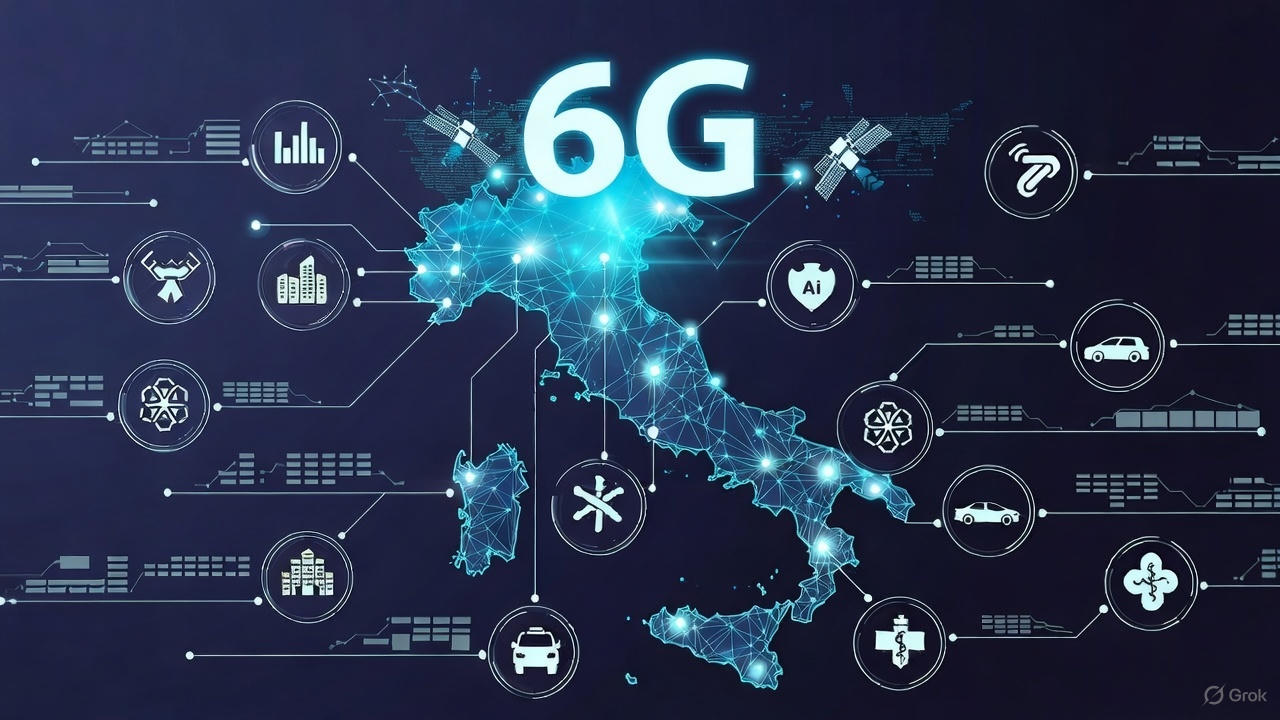
5G Is Already Old: What 6G Means for Business
6G arrives in 2030 with speeds 100 times higher than 5G. Discover its impact on telemedicine, Industry 4.0 and smart cities. Is Italy ready, or does it risk being left behind?
While Italy is still struggling to adopt 5G – only 2% of large companies use it strategically – the rest of the world is already working on the next revolution: 6G. A technology that promises speeds of up to 1 Terabit per second, latency on the order of microseconds and artificial intelligence natively built into the network.
The question is not whether it will arrive, but whether we will be ready.
5G in Italy: an opportunity already half wasted
The numbers speak for themselves. According to the 5G & Connected Digital Industry Observatory of the Politecnico di Milano, the industrial 5G market in Italy is worth just 10.5 million euros in 2025. A figure that, although up 43% on the previous year, remains marginal in the European context.
The problem is not coverage – which reaches almost 90% of the population – but actual adoption. Only 27% of Italian users make use of 5G services, a figure in line with the European average but dramatically distant from markets such as South Korea, where the average 5G speed is roughly double that of Europe.
Europe, once the cradle of 2G, is today structurally behind. And Italy, with 60% of its lines still on copper networks, risks accumulating a gap that will be hard to close.
6G: not just more speed
6G is not simply a faster 5G. It is a paradigm shift.
Sixth-generation networks will natively integrate artificial intelligence into every component, from traffic management to the automatic optimisation of resources. People speak of "zero-touch" networks: infrastructures capable of configuring themselves, diagnosing problems and improving on their own, without human intervention.
The concrete applications range from real-time remote surgery to holographic communications, from autonomous vehicles to smart cities with environmental sensors built directly into the network.
According to Qualcomm, the first pre-commercial 6G devices could arrive as early as 2028, with a commercial launch expected around 2030.
What it means for Italian companies
For the Italian business fabric, made up predominantly of SMEs, 6G represents both an opportunity and a threat.
Opportunity: those who know how to prepare will be able to access levels of automation, efficiency and innovation that are unthinkable today. Smart manufacturing, predictive logistics and real-time remote maintenance will become the competitive standard.
Threat: those who ignore this transition risk finding themselves out of the market. It is not a matter of adopting a technology, but of rethinking entire business models.
The problem is that many Italian companies still see digital as a cost, not as an investment. And this cultural, rather than technological, approach is the real obstacle to overcome.
Can Italy still catch up?
The European Union has allocated 900 million euros to the Smart Networks and Services programme, with the aim of completing standardisation by 2025 and deployment by 2030. In Italy, the RESTART project involves the Politecnico di Milano, the CNR and other institutions in research on THz bands, satellite communication and AI integration.
But research alone is not enough. What is needed is infrastructure investment, widespread skills and, above all, a strategic vision that is missing today.
As highlighted by Agenda Digitale, Italian telecommunications are going through a critical phase that reflects a broader European lag. The challenge is not only technological: it is industrial, cultural and political.
Source: Agenda Digitale - Italian telecommunications in crisis
Time is running out
6G will arrive whether we want it or not. China has been working on this technology since 2018, the United States and South Korea are accelerating, and Europe is trying not to lose further ground.
For Italian companies, the time to start preparing is now. Not by waiting for 2030, but by building today the digital foundations – infrastructure, skills, a culture of innovation – that will make it possible to seize tomorrow's opportunities.
Those who keep putting off digital transformation are not saving money: they are accumulating a technological debt that, sooner or later, will present the bill.
Source: Corriere Comunicazioni - 6G will be a reality in 2028