
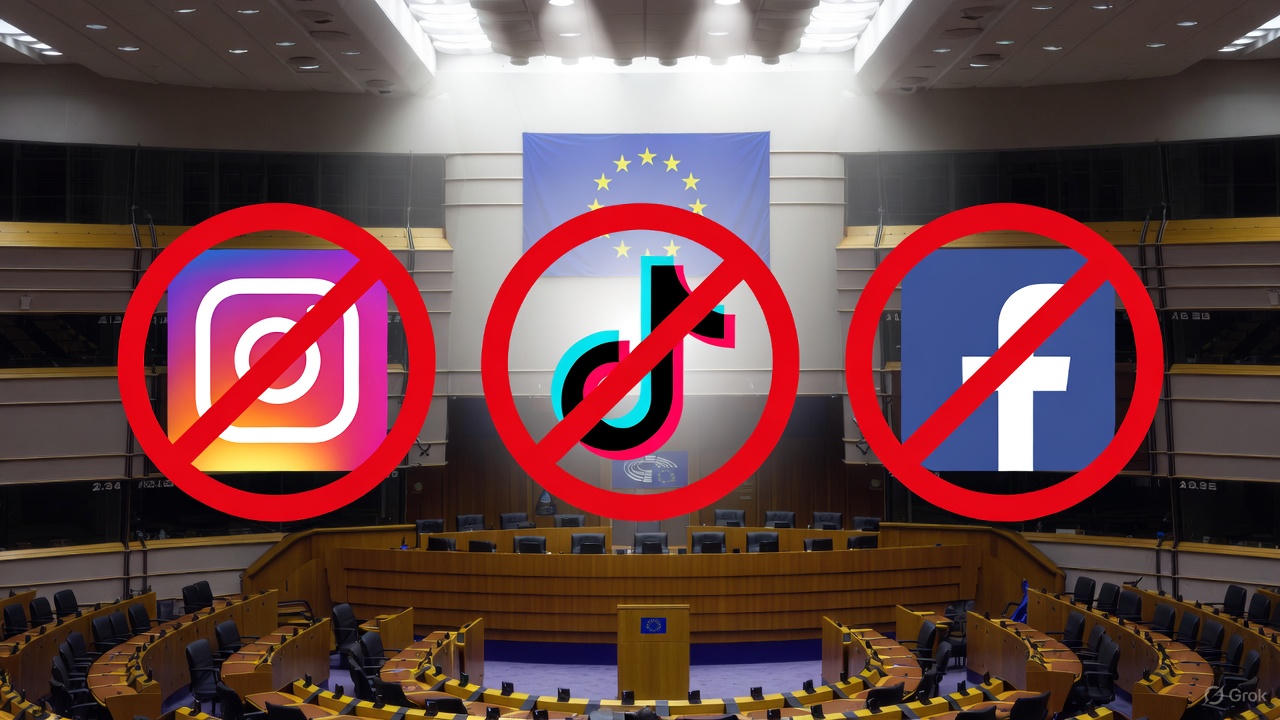
Social Media and Minors: the European Parliament Calls for a Minimum Age of 16
The European Parliament votes on a landmark resolution on the protection of minors online: a minimum age of 16 for social media, a ban on manipulative algorithms and loot boxes. What changes for families and digital companies.
26 November 2025 marks a turning point in European digital regulation. With 483 votes in favour, 92 against and 86 abstentions, the European Parliament approved a resolution calling for the minimum age to sign up to social media to be set at 16 europa, as well as to video-sharing platforms and to AI-based virtual companions.
The resolution, although not binding, represents a strong political message that could soon translate into concrete legislation. A clear signal to Big Tech: t**he era of self-regulation is coming to an end.**
Why This Decision: The Numbers Behind the Problem
The data speak clearly. 97% of young people use the Internet every day and 78% of minors aged 13 to 17 check their devices at least once an hour. But the most alarming figure concerns mental health: one minor in four shows "problematic" or "dysfunctional" smartphone use, with behavioural dynamics similar to addiction.
According to the 2025 Eurobarometer, more than 90% of Europeans consider it urgent to act to protect minors online, especially regarding the impact of social media on mental health, cyberbullying and the need for effective tools to limit inappropriate content.
What the European Parliament's Resolution Provides For
The resolution does not stop at setting a minimum age. Here are the key points.
Access age and parental consent. Minors aged 13 to 16 will be able to access social media only with parental authorisation. Parliament welcomed the development of an EU age-verification app and the European digital identity wallet.
Ban on addiction-creating practices. A stop to infinite scrolling, autoplay, pull-to-refresh and reward loops — all features designed to maximise time spent on the platforms.
Gaming and loot boxes in the crosshairs. The resolution calls for a ban on loot boxes, in-app currencies, wheels of fortune and pay-to-progress mechanisms.
Recommendation algorithms. Engagement-based recommendation systems are banned for minors — those that fuel the so-called "rabbit hole" and keep users glued to the screen.
Generative artificial intelligence. Urgent action is requested on deepfakes, companion chatbots and AI-based nudify apps.
Child influencers. A ban on platforms providing financial incentives for child influencers, a practice that is turning minors into marketing tools.
Personal Liability for Platform Managers
A particularly significant aspect concerns accountability. MEPs propose that platforms' senior management could be held personally responsible in the event of serious and persistent non-compliance with the provisions, especially those relating to the protection of minors and age verification.
It is a paradigm shift: no longer just fines for companies, but direct consequences for those who make the decisions.
The Scientific Debate: Social Media and Mental Health
The scientific community is still divided on the actual impact of social media on the mental health of young people. Some researchers point out that in 90% of the available studies it is not possible to distinguish cause from effect ipsico — it could be that young people with pre-existing problems spend more time online, and not the other way around.
Nevertheless, a study conducted between 2024 and 2025 showed that a week of "social media detox" led to significant reductions in symptoms of anxiety, depression and insomnia. smips
What emerges clearly is that minors, because of the incomplete maturation of the prefrontal cortex, tend to be more vulnerable to the addictive effect of online experiences, designed to generate instant gratification.
What It Means for Digital Companies
For businesses operating in the digital sector, this resolution represents a clear signal of direction. Companies will have to implement robust, privacy-respecting age-verification systems, redesign interfaces by removing manipulative patterns, review business models based on the compulsive engagement of minors, and prepare for greater legal responsibility for their executives.
Those who move early will have a competitive advantage when these guidelines become law.
Conclusions
As rapporteur Christel Schaldemose stated: "We are finally drawing a line. We are telling platforms clearly: your services are not designed for minors. And this experiment ends here."The European Parliament's resolution is not yet law, but it points precisely to the direction that regulation will take in the coming years. For companies, ignoring these signals is no longer an option.
Sources and further reading:
European Parliament - Official press release Eurobarometer 2025 - Protection of minors online EPRS study on the harmful use of the Internet among minors EPRS briefing on EU laws for the protection of minors online