
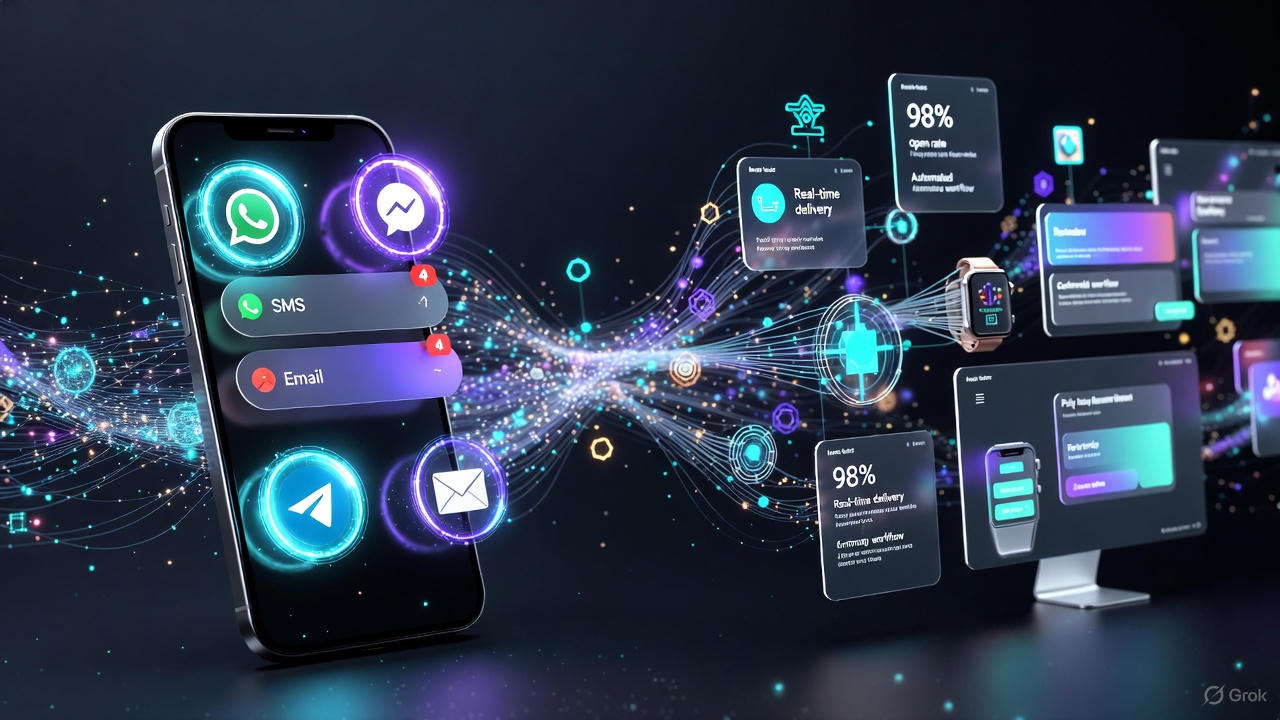
Multichannel Communication in the Insurance Sector
In insurance, where the client relationship hinges on precise timing and timely communications, relying on a single notification channel means losing business opportunities. The data is clear: WhatsApp reaches a 98% open rate against 20% for standard email.
Multichannel Communication in the Insurance Sector: How Email, SMS, WhatsApp and Telegram Boost Retention and Client Satisfaction
The Hidden Problem of Single-Channel Communication
The average insurance intermediary manages hundreds, if not thousands, of active policies. Each policy has its own expiry date, each client has their own communication preferences, each situation calls for a different approach.
The result of a single-channel strategy?
- Clients who never see the renewal notices
- Policies that are not renewed out of "forgetfulness"
- Avoidable loss of revenue
- Deterioration of the client relationship
- Operational overload for staff who have to "chase" clients
A telling figure: according to 2024-2025 email marketing statistics, the average open rate for commercial emails stands at around 20%. This means that 8 out of every 10 emails sent to clients to communicate expiry dates, quotes or updates are not even opened.
For an insurance intermediary, this is not just a communication problem: it is a business problem.
The Channels Compared: Not All Communicate in the Same Way
When it comes to notifications and communications in the insurance sector, there is no "absolute best" channel. There are channels that are more effective for specific goals.
Email: The Channel of Documentation
Average open rate: 20-44% (in Italy the benchmark is higher than the global average) Click rate: 2.6-3.25%
Email remains irreplaceable for:
- Sending complete documentation (quotes, no-claims certificates, policy terms)
- Formal and traceable communications
- Complex content that requires attachments
- Contractual confirmations
The drawback? An email can end up in spam, be ignored among hundreds of others, or simply be lost in the sea of daily notifications everyone receives. Insurance is not among the sectors with the highest open rates.
Email Marketing ROI: €42 for every euro invested - when the emails are opened.
SMS: The Urgency That Works
Open rate: ~95% Average time to read: 3 minutes from receipt
SMS is the channel of immediacy:
- Reminders of imminent expiry dates (-7 days, -3 days, -1 day)
- Appointment confirmations
- Urgent alerts
- Short, direct communications
The advantage? They arrive directly on the most consulted device of all: the phone. They require no internet connection, they have no complex spam filters, and they are read almost immediately.
The drawback? Limited space (160 standard characters), a cost per message, and not ideal for complex or document-based content.
WhatsApp: The King of Modern Communication
Open rate: 98% Response rate: significantly higher than email and SMS
WhatsApp has become the preferred communication channel for millions of Italians. In the insurance context it offers a perfect mix:
- Instant confirmations: "Your policy has been renewed"
- Fast documents: sending certificates, receipts and PDF certificates
- Conversational communications: the client perceives a dialogue, not a cold notification
- Rich media: the ability to send images, explanatory videos, links
- Two-way messaging: the client can reply easily
The competitive edge? It is the channel that clients check several times a day. A WhatsApp message does not go unnoticed.
The WhatsApp Business API also enables:
- Transactional messages (confirmations, reminders, documentation)
- Marketing messages (promotions, new products, campaigns)
- Full automation with integration into management systems
Telegram: The Channel for Tech-Savvy Clients
A growing adoption rate, particularly among professionals and enterprise clients
Telegram is emerging as a "premium" alternative to WhatsApp, especially for:
- Communications with corporate clients or professionals
- Sending large files (a 2GB limit vs WhatsApp's 16MB)
- Greater perceived privacy
- Advanced features (bots, broadcast channels)
It is not yet as mainstream as WhatsApp, but for an intermediary managing business clients or professionals, Telegram can become a differentiator.
The Multichannel Strategy: When to Use What
Effectiveness does not lie in using every channel at once, but in using the right channel at the right time.
Case 1: Motor Liability Policy Expiry (Private Client)
Communication timeline:
- T-30 days: Email with the renewal quote and complete documentation
- T-15 days: WhatsApp with a reminder "Your policy expires in 15 days. Would you like to confirm the renewal?"
- T-7 days: Short SMS "Reminder: your policy expires in 7 days"
- T-3 days: WhatsApp with a direct link for immediate renewal
- T-1 day: Final SMS "Last day to renew without a gap in cover"
Result: the client has received the documentation by email (which they can read at their leisure), but has been "woken up" with reminders on high-open channels at the critical moments.
Case 2: New Home Insurance Quote (Business Client)
Approach:
- First contact: A professional email with a detailed quote, terms and simulations
- Follow-up on day +2: Telegram or WhatsApp "Have you had a chance to look at the quote? Can I clarify anything?"
- Follow-up on day +5: SMS "The quote I sent you is still valid for 5 more days"
- Final reminder: A recap email + WhatsApp combined
Case 3: Claim in Progress (Maximum Urgency)
Immediate communications:
- WhatsApp for real-time updates on the status of the case
- Email for sending official documentation and formal communications with the insurer
- SMS for confirmations of payments/settlements
The Execution Problem: Automation Is Mandatory
Manually managing multichannel communications across hundreds or thousands of policies is materially impossible.
Imagine this scenario:
- 500 policies expiring in the month
- 3 reminders per policy across different channels
- = 1,500 communications to send manually
Time required: even just 2 minutes per communication = 50 hours of work just to manage the reminders.
And this is without counting:
- Quotes to send
- Confirmations to handle
- Client replies
- Managing errors and bounces
- Personalising the messages
There is only one solution: intelligent automation.
What You Need for Effective Multichannel Communication
It is not enough to have access to WhatsApp Business, SMS and email. You need an orchestrator system that:
1. Integrates with Your Existing Management System
The notification system must "talk" to your insurance management software. It needs to know:
- When policies expire
- Which communications have already been sent
- Which clients have already renewed
- Which need a follow-up
No integration = manual work = a system that does not scale.
2. Manages an Intelligent Message Queue
Not every message should be sent immediately. You need a queue management system that:
- Schedules sending at the optimal times
- Manages retries in the event of failure
- Avoids bombarding the client with too many notifications close together
- Respects each individual client's communication preferences
3. Tracks and Monitors Every Communication
You need to know:
- Which emails have been opened
- Which SMS have been delivered
- Which WhatsApp messages have been read
- Which clients have clicked on the links
This data is not "nice to have", it is essential to understand what works and what does not.
4. Enables Mass Personalisation
Every communication must be personalised, but without requiring manual work:
- Client name
- Specific policy details
- Precise expiry date
- Personalised links
- Dedicated contact person
"Dear Client" is no longer enough. "Hi Marco, your policy on the Fiat Panda, plate AB123CD, expires on 15 March" works.
5. Adapts to External Systems
Your technology ecosystem probably includes:
- A main management system
- A CRM
- Insurance company platforms
- Quoting software
- Digital signature systems
The notification system must integrate with them all, not replace them.
Concrete ROI: How Much Is Communicating Well Worth?
Let us do the maths with a real example of an average insurance agency:
Current scenario (email only):
- 1,000 policies under management
- Renewal rate: 75% (250 policies lost per year)
- Average premium: €400
- Revenue lost: €100,000/year
Scenario with optimised multichannel communications:
- Same portfolio: 1,000 policies
- Renewal rate: 90% (a conservative improvement)
- Average premium: €400
- Policies saved: 150
- Revenue recovered: €60,000/year
Cost of the multichannel automation system: ~€3,000-5,000/year
ROI: 1,200% in the first year
And this considers retention alone. We are not counting:
- Time saved by staff (50+ hours/month)
- Improved customer satisfaction
- Fewer human errors
- More effective cross-selling opportunities
- Improved reputation (clients feel better looked after)
Mistakes to Avoid
1. Multichannel Spam
Sending the same message across every channel at once is not a strategy, it is spam. The result: an irritated client who disables notifications.
2. Lack of Consistency
Every channel must carry the same basic message, but adapted to the format. Contradictions between email and WhatsApp create confusion.
3. Ignoring Preferences
Some clients prefer email, others WhatsApp. A good system lets you respect these preferences without complicating management.
4. Relying on Automation Alone Without Supervision
Automation is powerful, but it must be monitored. Errors in templates, integration problems, messages that go out at the wrong time: human supervision is needed.
5. Not Measuring the Results
If you do not track opens, clicks and conversions, you are flying blind. Every campaign must generate data to improve the next one.
The A126 Solution: NotEngine
At A126 we have developed NotEngine, a centralised notification management system designed specifically for complex business scenarios such as insurance.
What NotEngine Does
NotEngine is an intelligent orchestrator that:
Integrates with any external system
- RESTful APIs to connect with insurance management systems
- Webhooks for real-time events
- Compatibility with legacy and modern platforms
Manages multi-channel queues
- Email (SMTP, transactional services)
- SMS (multiple gateways)
- WhatsApp Business API
- Telegram Bot API
- Push notifications
Trigger-based automation
- Events from the management system → automatic notification
- Scheduled deadlines → multi-step sequences
- User replies → consequent actions
Complete tracking
- Real-time dashboard
- Analytical reports by channel
- Tracking of opens, clicks, conversions
- Alerts on send failures
Mass personalisation
- Dynamic templates with variables
- Conditional logic
- Automatic A/B testing
Why NotEngine for an Insurance Intermediary
NotEngine is not "yet another piece of software": it is the glue that connects your management system to your clients through the channels they prefer, without forcing you to change the way you work.
Example of an automated workflow:
- Your management system records a policy expiring in 30 days
- NotEngine receives the event via API
- It automatically generates:
- An email with the complete quote
- A WhatsApp reminder at -15 days
- An SMS at -7 days
- A final follow-up at -2 days
- It tracks who opens what
- If the client clicks "Renew", NotEngine notifies the management system
- Automatic confirmation on WhatsApp
All without manual intervention.
Conclusion: Communication Is Part of the Service
In the insurance sector, communication is not an accessory to the service: it is an integral part of the service itself.
A client who receives timely reminders, clear documentation on the channels they use every day, instant confirmations and transparent updates is a client who is:
- More satisfied
- More likely to renew
- More receptive to additional products
- More likely to recommend the intermediary
Conversely, a client who "discovers" that their policy has expired, who has received no communications, who has to chase the intermediary to get documents, is a lost client.
Technology today makes it possible to offer a level of service unthinkable even just 5 years ago. Email, SMS, WhatsApp, Telegram: these are not competing channels, they are complementary tools of a modern communication strategy.
But it takes a structured approach:
- Integration with existing systems
- Intelligent automation
- Continuous tracking and optimisation
- Scalable personalisation
The cost of not doing it? Lost clients, missed opportunities, operational inefficiency.
The advantage of doing it well? Higher retention, more satisfied clients, a more efficient team, a more scalable business.
Want to Implement a Multichannel Communication Strategy?
A126 Corporate Advisors helps insurance intermediaries and service companies digitalise their communications with clients through integrated, bespoke solutions.
With NotEngine and our strategic consulting, we turn communication management from an operational problem into a competitive advantage.
Get in touch for a free consultation in which we analyse together:
- Your current communication flow
- The most effective channels for your client portfolio
- The integration with your existing systems
- The expected ROI of the implementation
A126 Corporate Advisors - Where technology meets operational efficiency.