
Italy Out of the 2026 World Cup: What It Teaches SMEs About Tailor-Made Management Systems and Organisational Continuity
Fifteen days after the Zenica defeat the league is already back and no one talks about the national team any more. This is exactly how systemic problems survive in organisations: they are not solved, they are forgotten.
Zenica, 31 March 2026. And then, silence
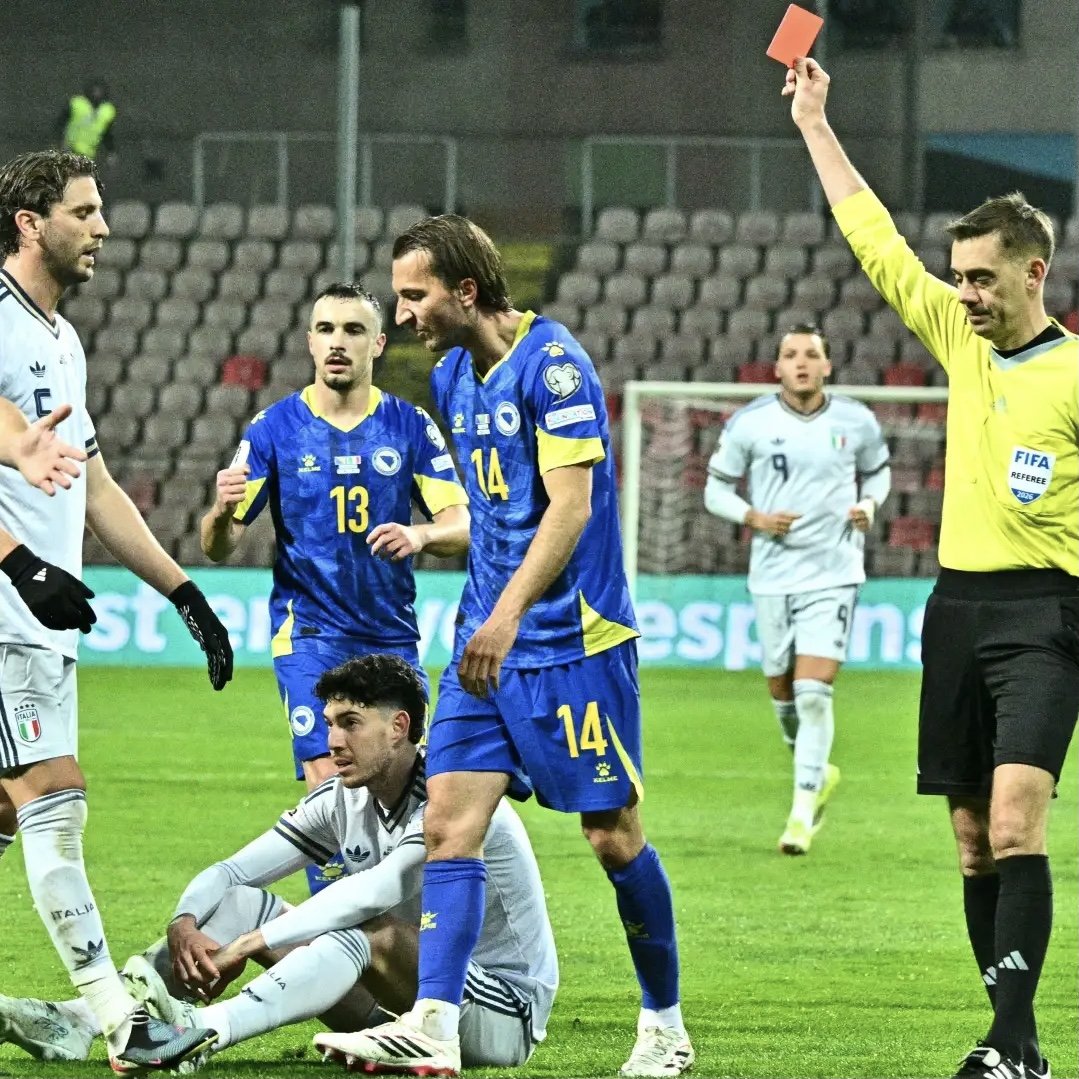
For the third consecutive time, Italy will not be going to the World Cup. After 2018 and 2022, the evening in Zenica added another chapter to a story that has now lasted twelve years: the Azzurri's last appearance at a World Cup dates back to 2014, in Brazil. On penalties, against a Bosnia and Herzegovina side that on paper was worth far less, an elimination played out that was not just a bad night but the endpoint of a foretold decline.
The most interesting thing, however, happened afterwards. Just fifteen days. That is how long the debate lasted. Then, on Saturday 4 April, the league season resumed, the stadiums filled up, and the fans went back to arguing about the title race, the Champions League and the transfer market. Almost no one talks about the national team any more. The systemic problem has barely been addressed: it now waits for the next play-off, in 2030. Or perhaps for an unlikely reinstatement.
This is exactly how organisational crises survive. Not because someone decides to ignore them, but because the daily operational grind is stronger than strategic reflection. And this dynamic does not concern football alone: it concerns a great many Italian businesses.
The pattern the data had been showing for years
Anyone who watched the national team with an analytical rather than an emotional eye could see Zenica coming from a long way off. Three signals in particular deserve attention, because they are the same ones that appear when a company is losing its edge without realising it.
The first is discontinuity of method at the top. From 2014 to 2026, the Azzurri bench passed from Conte to Ventura, then Di Biagio as caretaker, then Mancini, Spalletti, Gattuso. Six head coaches in twelve years, each with his own philosophy, his own staff, his own selection criteria. Every change was a small refounding, with new formations, new principles of play, new lists of players. There was no shared federal method that outlived the individual coach: there was only the coach of the moment. Readers who work in a company will recognise the pattern: the sales director changes and for six months everything grinds to a halt, because the previous method lived in the head of a single person and had never been codified anywhere.
The second signal is data fragmentation. The youth academies of Italian clubs collect information on their young players: match statistics, physical parameters, tactical assessments, development paths. But this information stays in the silos of individual clubs; it does not flow into a shared federal infrastructure capable of following a player from the age of twelve up to the senior national team. Federations such as Germany's, following the refounding plan launched in the early 2000s, invested heavily in standardised technical centres and structured data collection. The result became visible over the following twenty years. The business parallel is immediate: the CRM used by sales, the Excel file of the production manager, the accounting software of the finance department and an ERP that no one really keeps up to date. Three or four different "truths" about the same customer, the same order, the same process. And no dashboard to unify them.
The third signal is dependence on individuals. When Buffon retired, when Chiellini retired, when Chiesa got injured, the system had no redundancy. Not because there was no talent coming through — there was — but because the development path was not codified enough to turn individual talent into systemic reliability. It is the same problem faced by tens of thousands of Italian SMEs where "only Luigi knows the procedure", and when Luigi goes on holiday, or worse changes jobs, he takes a piece of the company with him.
Anyone wishing to reconstruct the full qualifying campaign and understand exactly how it came to Zenica can consult the Wikipedia entry on the 2026 World Cup qualifiers - UEFA, which systematically gathers data, dates and results.
The same script, in Italian companies
Here the parallel stops being a metaphor and becomes a diagnosis. Because the three symptoms that took Italy out of the World Cup are the same ones afflicting a huge part of the Italian economy, which according to Istat data is made up for more than 95% of small and medium-sized enterprises, and which for at least fifteen years has been facing a slow, fragmented and often frustrating digital transformation.
First pathology: every change at the top is a refounding. When a department head changes in an Italian company, in 90% of cases the working method leaves with them. The newcomer finds a few scattered files, a handful of poorly organised shared folders, colleagues describing "how it used to be done" in slightly different versions, and finds themselves forced to reinvent the wheel. The problem is not staff turnover, which is natural and healthy: the problem is that the organisation has no memory independent of its people. The processes are not written into any system; they are imprinted in individual habits. And when people change, the habits scatter.
Second pathology: the data exists but doesn't talk to itself. It is rare to find an Italian SME that has no data. On the contrary, it has too much. The problem is that this data sits in different places, in different formats, updated at different frequencies and often inconsistent with one another. The salesperson keeps their own Excel file "because the management system is awkward". Production uses vertical software that does not integrate with accounting. The warehouse has a twelve-year-old application that no one dares touch any more. The result is that when the owner asks "how much have we billed this customer over the last two years, and at what margin", the answer takes half a day of manual work and comes with an asterisk.
Third pathology: knowledge is held hostage by people. Every SME has its own "Luigis". Excellent, valuable, irreplaceable people in the literal sense of the word: if they leave, the company stops. That is not a compliment, it is an operational risk. When company know-how lives only in employees' heads, the business is exposed to a risk that no balance sheet quantifies but that every entrepreneur knows.
These three pathologies share a common denominator: the organisation was never designed as a system; it grew as a sum of people. As long as everything goes well, the system holds. At the first stress — a change of staff, a market crisis, a better-organised competitor — the truth emerges: there was no system, there were only people who did their best every day to hold it together.
Building a system: it's not about buying software
An important clarification is needed here, because the risk of the typical article on digitalisation is that it ends with "buy the right software and everything will be solved". It does not work like that, and anyone who has seen digitalisation projects fail up close knows it well.
Building a system means first understanding how the organisation really works, and then designing digital tools that make that way of working repeatable, measurable and independent of individual people. The order of the factors is decisive. Standard management systems, bought as off-the-shelf packages, impose a predefined logic on the company: if that logic coincides with the way the company already works, all is well. In practice, it almost never coincides. And the result is one we all know: the official software is used for the mandatory screens, while the real work goes on happening in personal Excel files.
Tailor-made management systems start from the opposite direction. The company's real processes are analysed, the points where knowledge risks being dispersed are identified, and a digital tool is built that reflects those processes instead of overwriting them. The difference is subtle in words but enormous in practice: in the first case, people have to adapt to the software; in the second, the software adapts to people, and in doing so captures and preserves their way of working, turning it into a company asset.
Vertical micro-applications and integration with existing systems
The same applies to vertical micro-applications, which are the concrete alternative to the "big ERP that does everything badly". Instead of a single system trying to cover every company function (and ending up mediocre everywhere), specific applications are built that solve a specific problem well — policy management for a broker, service-call tracking for a maintenance company, project cost control for a construction firm — and are integrated with the systems already in place. Nothing is thrown away, everything is brought into communication.
This is the alternative to the all-or-nothing logic that paralyses so many companies. You do not have to replace what you have; you have to make it talk and fill the gaps.
The national team will try again in 2030. Companies won't
Italian football will have another chance in 2030. Four years to rethink the system, refound the method, build an infrastructure that outlives the next change of head coach. Whether they will be used for that or only to look for a new "man of providence" on the bench, we shall see.
Companies do not have this luxury. There is no play-off every four years: there is daily pressure made up of better-organised competitors, more demanding customers, people who change jobs, data that becomes obsolete. Postponing the digitalisation of business processes means accumulating an organisational debt that sooner or later comes due — usually at the worst possible moment, when you need to respond quickly to an opportunity or a crisis.
A126 Corporate Advisors supports companies along this path with an approach born of a precise conviction: applications must adapt to the organisation, not the other way around. We design tailor-made management systems and vertical micro-applications that integrate with the systems already in place in the company, without imposing traumatic upheavals, and that turn people's know-how into stable digital infrastructure.
If you are recognising your own company in some of the signals described in this article — methods that live in people's heads, data scattered across systems that don't talk to each other, processes that depend on a few irreplaceable names — it is time to tackle the problem before your play-off arrives. Contact us for an exploratory consultation: together we will analyse your current situation and build a realistic digitalisation path that starts from your real processes, not from a packaged piece of software.
A126 Corporate Advisors — Tailor-made applications for organisations that want to last.