
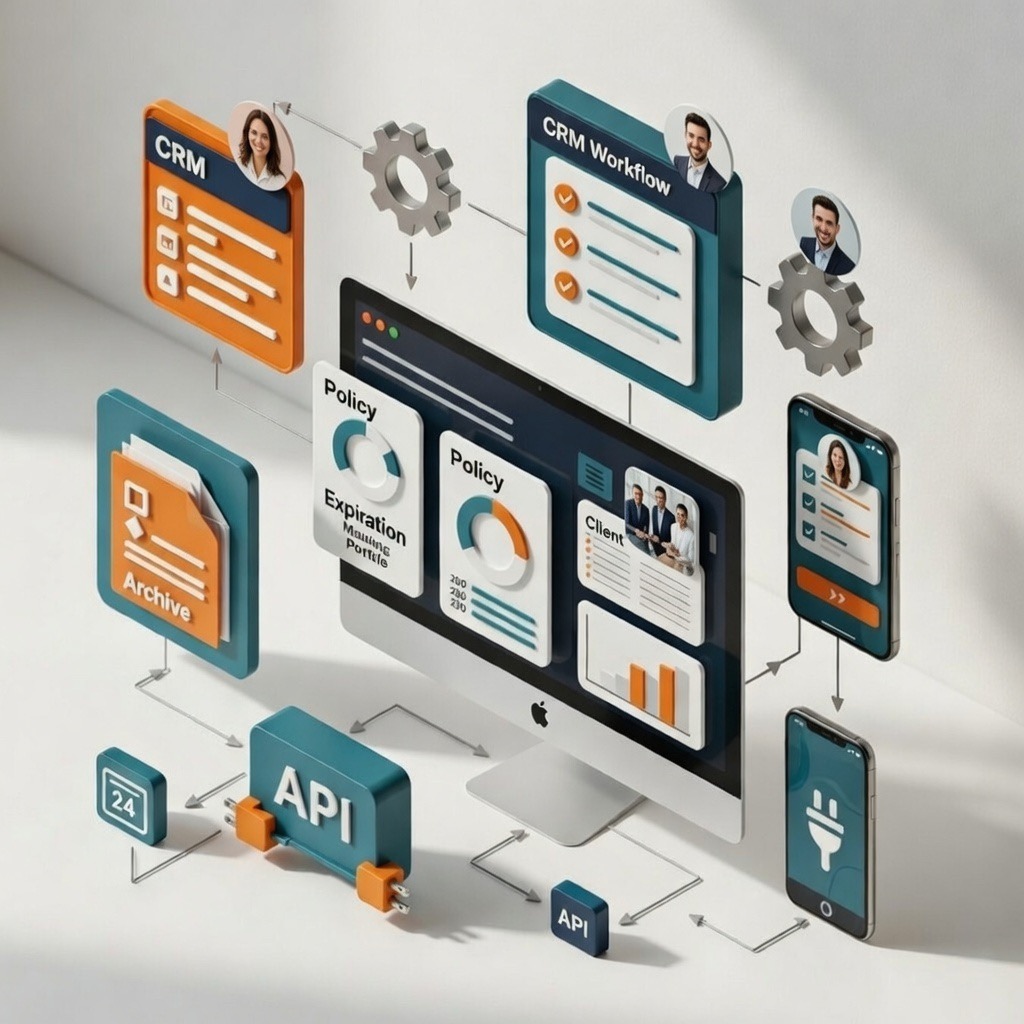
Insurtech for Intermediaries: Products That Transform Management
Discover which digital products to build to genuinely do insurtech - starting from processes, not from software
62% of Italian intermediaries have already invested in technology over the last 24 months, but many have ended up with inadequate tools. Here is which digital products to build to genuinely do insurtech - starting from processes, not from software.
In the previous article we tackled a question of method: the digitalisation of an insurance intermediary must start from how you work today, not from the software someone wants to sell you. If you read that reflection and recognised yourself in the problem, established processes forced into rigid management systems, features you don't use and key functions that are missing, then this article is the next step.
The question now is concrete: once you have mapped your processes and know exactly what you need, which technology products can you build? We are not talking about adopting a generic SaaS, but about developing tailor-made digital tools that become a real competitive advantage. Tools that speak your operational language, integrate with the insurers you work with and grow together with your organisation.
The Italian insurtech market exceeded 236 million dollars in value in 2024, with projections that take it to 3.7 billion by 2033, according to IMARC Group. But these figures concern mainly the large insurers and startups. Intermediaries, agents, brokers, agency networks, are often spectators of this transformation, not protagonists. And yet they have everything it takes to become protagonists: knowledge of the client, product specialisation, established relationships. All that is missing is the right digital infrastructure.
The Starting Point: What It Means to Do Insurtech as an Intermediary
Before talking about products, it is worth clarifying what "doing insurtech" concretely means for an insurance intermediary who is not a startup and does not want to become one.
It is not about reinventing the business model. It is about digitalising the operational processes that today consume time, generate errors and limit scalability. An intermediary who does insurtech is one who has automated deadline management, who offers their clients a digital personal area, who has structured data on their own portfolio and uses it to make smarter commercial decisions.
According to the Italian Insurtech Association, 77% of consumers bought motor policies digitally over the last 12 months, but 86% of professionals still require clarity, transparency and human support during the process. This figure is fundamental: technology does not replace the intermediary, it amplifies their ability to be present and responsive. A well-built client portal does not eliminate the relationship, it frees it from administrative tasks and concentrates it on advice.
Since 17 January 2025 the DORA — Digital Operational Resilience Act, the European regulation on the digital resilience of the financial sector, has come into application. For larger intermediaries this introduces explicit obligations on the management of ICT risks. For everyone else it is a clear signal: digitalisation is no longer a strategic option but a structural component of future compliance.
The Operational Management Products an Intermediary Can Build
Operational management is the heart of an intermediary's activity. It is also the area where inefficiencies accumulate silently, consuming hours of work that could be devoted to clients. The digital products in this field are nothing spectacular, but their impact on the organisation is immediate and measurable.
White-Label Client Portal
The client portal is probably the product that generates the greatest visible impact, because it changes the way the policyholder interacts with their intermediary. In practice it is a digital personal area, accessible from a browser or mobile app, where the client can view their active policies, download documents, check deadlines and, in some cases, independently start reporting a claim.
The concept of "white-label" is fundamental: the portal must carry the intermediary's visual identity and brand identity, not that of whoever developed it. For the end client, the experience must be consistent with the relationship they have with their agent or broker, they must not feel redirected to a third-party platform.
A tailor-made client portal makes it possible to decide exactly which features to expose, how to organise the information and which processes to automate. A broker specialising in corporate policies, for example, has completely different needs from a generalist agent: the portal must reflect this specialisation, not flatten it.
A CRM Specific to the Policy Portfolio
Generalist CRMs, the ones created to manage sales pipelines in different sectors, are not designed for the complexity of a policy portfolio. Managing an insurance contract means keeping track of technical deadlines, premiums, guarantees, any open claims, tacit renewals and much more. A standard CRM struggles to model this complexity without heavy customisation.
A CRM built specifically for an insurance intermediary instead starts from the data that really matters: the client portfolio with all active policies, deadlines ordered by priority, cross-selling opportunities identified automatically based on existing coverage. The difference is not just one of interface, but of the underlying data logic.
The automations you can build on a CRM of this kind are very concrete: automatic notifications to clients with expiring policies, internal alerts for staff when a client has not renewed for a certain number of days, weekly reports on the state of the portfolio for the commercial manager. All of this without anyone having to remember to do it manually.
IVASS-Compliant Digital Document Management
Regulations require insurance intermediaries to retain documents relating to proposals and contracts for at least 5 years, under ISVAP Regulation No. 5/2006, which remains the main reference even in 2025, supplemented by the provisions of the Digital Administration Code and the AgID Guidelines.
Handling this obligation manually, with physical archives or unstructured shared folders, is a constant source of operational risk and wasted time. A tailor-made digital document management system solves this problem structurally: documents are archived automatically in the right categories, are associated with the correct client and policy, and are always available in certified digital format.
The advanced electronic signature, integrated into these systems, eliminates the need to exchange paper documents to sign new contracts. The client signs from their device, the document is archived automatically, the case is closed in a matter of minutes. This is not a technical detail: it is a radical change in the purchasing experience for the client and in operational speed for the intermediary.
Distribution and Sales: The Products That Take the Intermediary Online
Operational management is the foundation, but for an intermediary who wants to do insurtech the next step is to take their distribution capability online, without losing the personalisation that sets them apart from generic policy comparison sites.
Quotation Engines and Product Configurators
A quotation engine embedded in the intermediary's website is a tool that allows the prospective client to obtain a personalised quote directly from the web page, without having to call or send an email. But the difference between a generic quotation engine and a tailor-made one lies in the depth of personalisation.
An intermediary specialising in a specific sector, say professional liability for healthcare professions, has their own risk assessment algorithms, pricing criteria that reflect years of experience in the segment, and specific questions that generalist comparison sites do not ask. A tailor-made configurator codifies this expertise and makes it available online 24 hours a day, generating qualified leads rather than mere quote requests.
API Integrations with Insurers
The most advanced insurance companies today expose APIs, programming interfaces that allow external systems to query their quotation engines and issue policies in real time. For an intermediary, exploiting these APIs means being able to build fully digital operational workflows: the client enters the data into the portal, the system queries several insurers in real time, presents the available options and allows immediate issuance.
Implementing these integrations requires specific technical skills, every insurer has its own specifications, its own authentication protocols, its own data formats. But the result, once built, is a competitive advantage that is hard to replicate: the intermediary becomes able to serve clients with the same speed as a digital platform, while retaining the advisory depth a platform cannot offer.
Data Intelligence: Turning the Portfolio into a Strategic Asset
An intermediary with ten years of activity has accumulated a huge data asset: thousands of clients, tens of thousands of policies, claims history, renewal behaviour. In most cases, this asset is scattered across unstructured management systems, Excel sheets and paper archives. Analytics products make it readable and actionable.
Analytics Dashboard on the Client Portfolio
A dashboard built on an intermediary's real data answers concrete operational questions: how many policies expire in the next quarter? Which clients have no life coverage? What is the renewal rate by product and by staff member? Where is the portfolio risk concentrated?
These are not academic questions, they are the questions every commercial manager asks every week, often without having the data to answer them precisely. A well-designed dashboard turns instinct into an informed decision, and makes it possible to identify commercial opportunities that would otherwise remain invisible.
How All This Is Built: The Method That Counts
Having a clear idea of the products you can build is necessary, but not sufficient. The risk is the same one described in the previous article, only reversed: instead of adapting to standardised software, you risk building something too ambitious, too complex, or simply not aligned with the organisation's real processes.
The right method is incremental. You start from mapping the processes, what you do today, where you lose time, what breaks when you are away, and you identify the product that generates the greatest impact with the least complexity. Often it is not the most spectacular product. Often it is a CRM with the right automations, or a document system that eliminates the chaos of the archives.
From there you build, you use, you adjust. The advantage of custom-developed software is exactly this: it is not a finished product you have to accept as it is, but a system that evolves with your organisation. Features are added when they are needed, not when the vendor decides to include them in the next plan.
This approach requires a technology partner who understands the insurance sector, not just the technology. One who can translate the complexity of a policy portfolio into a coherent data structure, who knows the IVASS regulatory constraints, and who has already dealt with the technical specifications of integrations with Italian insurers.
Conclusion
Doing insurtech as an intermediary does not mean becoming a technology startup or investing capital on the scale of a large insurer. It means building, methodically and gradually, a digital infrastructure that is truly yours, that reflects how you work, that adapts to your specialisations and that grows together with your organisation.
The products exist. The technologies are mature. The market, as shown by the data from the Fintech & Insurtech Observatory of the Politecnico di Milano, with the sector's median revenue up 29% in 2025, rewards those who know how to use them well.
The question is not whether to digitalise, but with which tools to do it so that it is an advantage, not a constraint.
If you are considering which technology product to build for your insurance brokerage business, A126 Corporate Advisors can help you start from the right place: your processes. We offer a free initial consultation to map the specific digital opportunities in your organisation and identify the product with the greatest immediate impact.
Contact us for a free consultation.
A126 Corporate Advisors - Technology Partner for Insurance Intermediaries Who Want to Grow.