
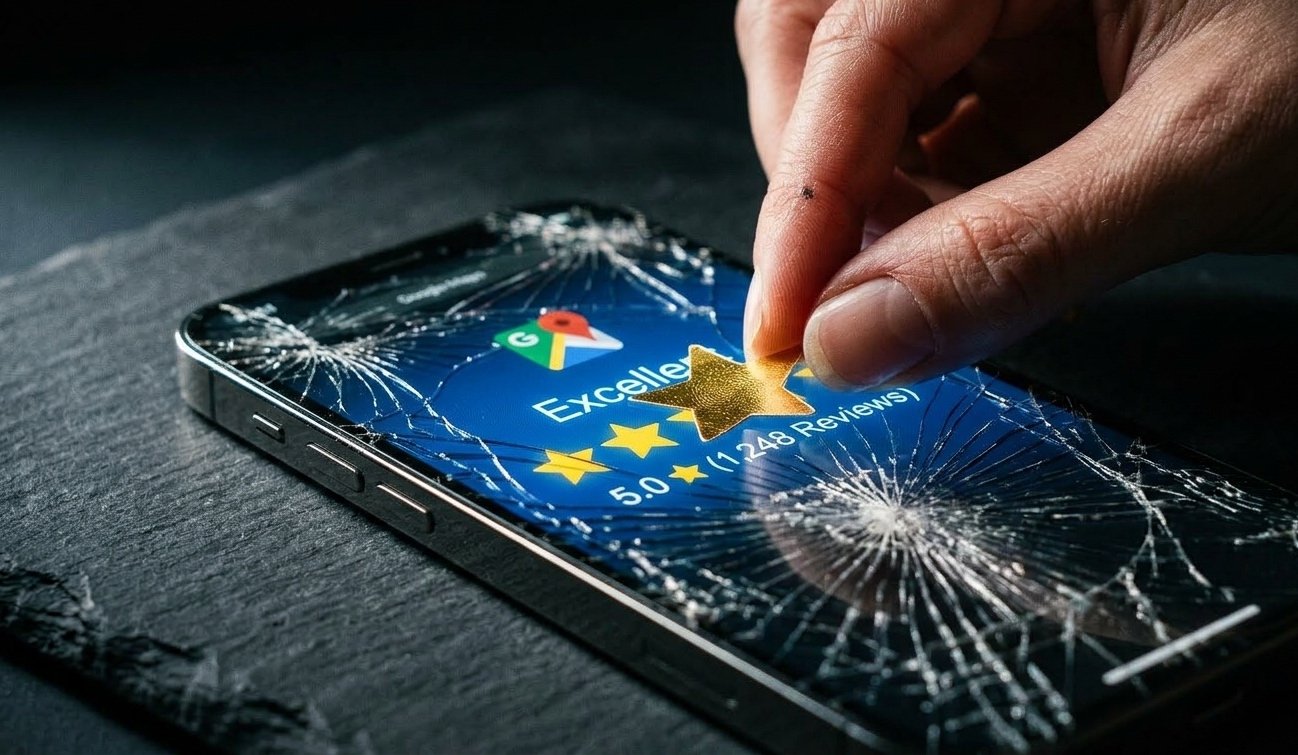
Fake Online Reviews: the 2026 SME Law Changed the Rules. Here's What You Need to Know
From 4 March 2026, fake reviews are illegal in Italy. The SME Law defines when a review is valid, bans buying and selling them, and sets a two-year limit beyond which even genuine reviews lapse.
On 4 March 2026 the Senate gave final approval to the Annual Law for micro, small and medium-sized enterprises, the so-called SME Bill A.S. 1484-B, awaited for more than ten years. Among the provisions of greatest relevance to those working in the digital sector is a section that, until a few weeks ago, seemed like regulatory science fiction: fake online reviews are now illegal in Italy, with precise rules on what makes a review valid and with enforcement powers assigned to the Italian Competition Authority.
For anyone running an e-commerce store, a booking site, or a presence on Google Business or Trustpilot, this law is no minor detail. It is a structural shift in how digital reputation works and in how it must be built.
What the law actually says
Articles 18 to 21 of the SME Law 2026 set out precisely when an online review is considered lawful. It must be published within 30 days of the date the product was used or the service was enjoyed. It must come from someone who actually and personally used that product or service. And it must not have been obtained through incentives, discounts or any other economic benefit offered in exchange.
There is also a time limit in the other direction: reviews are no longer considered lawful after two years from their publication. This means the stars accumulated years ago do not count forever. The system renews itself, and those who stop collecting authentic feedback lose ground over time.
Reviewed businesses can now formally request the removal of reviews that fail to meet these requirements. The law also introduces an explicit ban on buying or selling online reviews, with investigative and sanctioning powers assigned to the AGCM. In essence, the entire parallel market in fake reviews — from packages of stars sold online to bought-reputation agencies and review-swapping groups — becomes actionable.
Why this rule arrives now
This is not a law born out of nowhere. It fits within a broader European context. The Omnibus Directive 2019/2161, transposed into Italian law in 2023, had already introduced the obligation for platforms to declare whether the reviews they published were verified or not. The Digital Services Act imposes strict transparency obligations on large marketplaces regarding user-generated content. The SME Law 2026 goes further: it does not stop at transparency, but defines criteria for the substantive validity of the review itself.
The market context justifies the intervention. According to the most authoritative estimates, between 30 and 40 percent of online reviews worldwide are inauthentic. In Italy the phenomenon is especially widespread in tourism, hospitality and product e-commerce. A hotel with a hundred fake five-star reviews outranks in search results a competitor with fifty genuine and honest ones. The competitive distortion is measurable, and the law acknowledges that the market will not correct itself on its own.
Who is really affected
Media attention has focused on tourism and hospitality, the sectors most often cited in the text, but it would be a mistake to limit the reading to those industries. The rule applies to any economic operator offering products or services subject to public online review. This includes e-commerce of every category, professional firms, agencies, software houses, consultants and any business whose digital reputation runs through third-party platforms or its own Google listings.
The question every digital entrepreneur should ask is not "am I in the right sector to be exempt?", but "do I have reviews on my profile that fail to meet these criteria?". Because if the answer is yes and someone decides to report it, the legal framework to act already exists.
The real problem for those who built their reputation the wrong way
There is an issue that no press release states explicitly but that is worth confronting: over the years, many Italian companies have built their online reputation in ways that do not comply with this law. Reviews incentivised with discounts on the next purchase, aggressive requests to customers who had not yet finished using the product, packages bought from opaque agencies. Often not out of bad faith, but because the system allowed it and everyone did it.
Now the system is changing. And anyone with an artificially inflated base of reviews has a problem that will not be solved by waiting. Digital reputation built on fragile foundations becomes a legal risk as well as a reputational one. The right path is not the removal of existing reviews — a complicated and often counterproductive operation — but the systematic building of a genuine review base, integrated into business processes in a structured way.
What it means in practice for those running an e-commerce store or a company website
The law demands a change of approach, not just a clean-up. Asking a customer for a review is still lawful and indeed advisable, but it must happen after the service has been fully delivered, within 30 days of use, without economic conditioning and addressed to someone who genuinely used the product. This means integrating the feedback request into post-purchase flows in an automated and documentable way.
It also means actively monitoring your own listings on the main platforms to identify reviews that do not meet the new criteria. The law recognises the right to removal both for positive reviews built artificially and for potentially fake negative ones left by competitors.
And it means taking the two-year limit into account. Old reviews lose their lawful status, and anyone who stops collecting authentic feedback today will find themselves with an increasingly empty profile in the years ahead, regardless of how many stars they accumulated in the past. Digital reputation becomes an asset that is actively maintained, not a fixed inheritance.
Companies that already have a solid base of authentic reviews, even if smaller in number, emerge from this regulatory change with a real competitive advantage over those who played with shortcuts.
How A126 can help you build a solid digital reputation
At A126 Corporate Advisors we treat digital reputation as an integral part of marketing and online-presence strategies. It is not just about collecting reviews: it is about designing digital touchpoints such as websites, e-commerce stores, CRMs and post-purchase email flows so that gathering authentic feedback becomes a natural, automated and compliant process.
If you are building an e-commerce store from scratch or want to put your digital presence in order before the law really starts to bite, the right moment to do so is now — not when the damage is already visible.
Book a free 15-minute exploratory consultation at a126.it/contatti. Together we assess your current situation and show you where to start.