
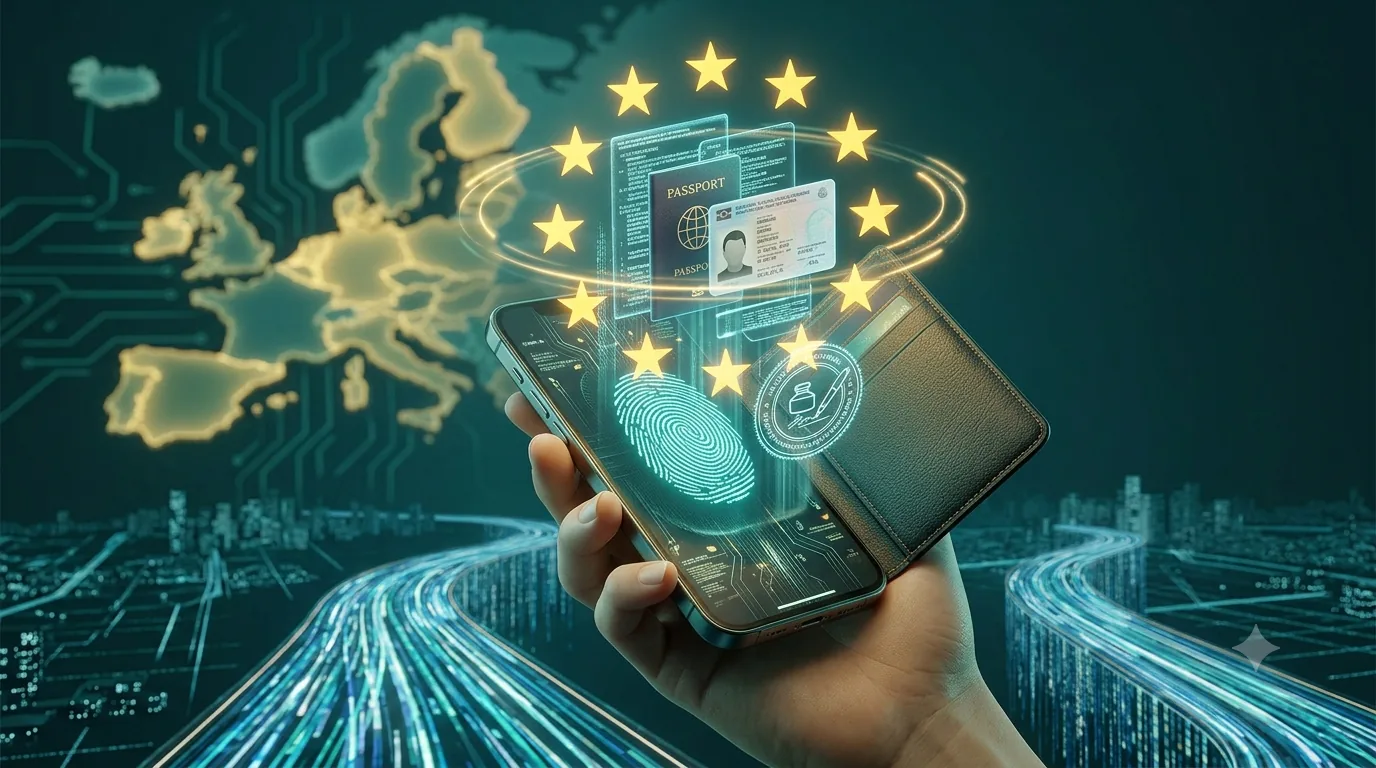
European Digital Identity: by December the EUDI Wallet arrives — here is what changes for companies and clients
By 24 December 2026 every Member State must make the European digital identity wallet required by eIDAS 2 available to citizens. From December 2027, banks, insurers, telcos and energy providers will be obliged to accept it. For companies this is not something to put off: it is the future of client onboarding.
A wallet in your phone, valid across Europe
Imagine a client who opens an account, takes out a policy or activates a supply contract by showing, from their phone and in a matter of seconds, a European-level verified identity: no photocopies of their ID card, no selfie holding the document, no forms copied out by hand. This is exactly what the EUDI Wallet — the European Digital Identity Wallet — promises, and it is not some project of the distant future: Regulation (EU) 2024/1183, the so-called eIDAS 2, sets 24 December 2026 as the deadline by which every Member State must make at least one free wallet available to its citizens.
Only a few months remain, and Italy is among the most advanced countries: those who have the IO app have already seen, with IT-Wallet, digital versions of their driving licence and health card arrive. The European wallet is the next step: a certified container of identity and attestations, recognised across the Union, with which the citizen decides what to share, with whom and for how long.
The two dates companies must mark down
The eIDAS 2 timeline has two deadlines of a different nature, and confusing them creates the wrong expectations.
The first is the end-of-2026 deadline just mentioned, and it concerns the states: by 24 December they must make the wallet available to citizens. From that moment the wallet exists, but whether or not to use it remains the citizen's choice — the rules expressly prohibit discriminating against those who do not adopt it.
The second concerns private entities, and it is the one that closely affects many companies: from 24 December 2027, service providers in regulated sectors — banks, insurers, telecommunications, energy, transport, healthcare, education — will be obliged to accept the EUDI Wallet as a means of identification whenever strong authentication is required to access the service. The obligation does not fall on micro and small enterprises, but it sets the standard towards which the whole market will converge: once your clients get used to identifying themselves in three taps with their bank and their telephone operator, your company's paper form will suddenly look antiquated.
What is inside the wallet (and why it is more than an SPID)
The temptation is to think of the EUDI Wallet as "another SPID". That is a reductive reading. Besides the personal identity, the wallet will be able to contain verifiable electronic attestations: academic qualifications, professional certifications, licences, powers of attorney, certifications. And it includes an element worth its weight in gold for companies: the ability for the citizen to apply free qualified electronic signatures for non-professional use, directly from their phone.
Anyone who read our article on the digital onboarding of insurance clients will recall the point: the signature is often the last mile that forces you to break an otherwise smooth digital journey. A client who arrives with a wallet capable of identifying them with certainty and of signing in a qualified way changes the economics of that journey: what today requires dedicated recognition procedures will, tomorrow, be a request for credentials from the wallet. We already touched on this when discussing digital signatures for brokers: eIDAS 2 is the reason to build signing and identification processes today that are designed to last.
There is also a chapter dedicated to companies as such: the business wallet, the wallet for legal entities. A company will be able to present, in a verifiable way, its legal identity, the signing powers of its representatives and data drawn from official sources such as the business register. In B2B relationships — where days are currently lost verifying company records, powers of attorney and signing authority — it is a step change.
What it means in practice for an SME
For most Italian companies, the EUDI Wallet entails no immediate obligations. It does, however, call for three reflections to make now, because processes are changed before they become urgent.
Client onboarding must be designed "wallet-ready"
If you are redesigning your website, your client portal or your registration flow, the question to put to whoever designs it is: will this journey be able to accept credentials from the wallet without being rewritten? A clean architecture — data collected only once, identification kept separate from the rest of the flow, open standards — is good practice today; tomorrow it is the requirement for connecting to the wallet through an adaptation rather than a rebuild.
Less data collected, fewer risks
The wallet flips the logic of data collection: instead of photocopying an entire document, the service asks only for the attribute it needs (are you of age? do you reside in Italy? are you you?). It is the direction already set out by the GDPR on minimisation, and it pays to anticipate it: every piece of data you do not collect is a piece of data you do not have to protect, store and justify.
Regulated sectors start now
If your company operates in banking, insurance, telecoms, energy, healthcare, or works with these sectors, 2027 is just around the corner: integration projects begin in 2026, not in November 2027. And those who move first turn an obligation into an advantage: faster onboarding than competitors, fewer drop-offs, fewer documentary frauds.
In summary
By 24 December 2026 the EUDI Wallet will be a reality available to European citizens; from 24 December 2027 regulated sectors will have to accept it. In between lies the time — not much of it — in which companies decide whether to endure this change or ride it. The wallet is not a compliance obligation: it is an infrastructure that will make identification and signing simpler, more secure and faster, and it will reward those whose digital processes are ready to embrace it. The smart move is not to wait for the obligation, but to design, starting today, client journeys able to talk to it.
At A126 we design onboarding journeys, client portals and signing flows built on open standards and ready for European digital identity. If you want to understand how to prepare your processes for the arrival of the wallet, contact us for a free consultation.
A126 Corporate Advisors — digital processes ready for the Europe that is coming.