Automating Internal Processes with AI: Concrete Use Cases for SMEs Across Email, Invoices and Reporting
Only 16% of Italian companies with at least ten employees use artificial intelligence, yet the average cost of processing an invoice manually is 8.50 euros versus 0.80 euros with automation. Four concrete cases to start where it really matters.
The real cost of repetitive work
Anyone who runs an Italian SME knows exactly where the time goes. Emails to sort, invoices to enter into the management system, reports to build on Thursday evening for Friday's meeting, documents to classify, data to copy from one system to another. These are activities no one values, because they generate no direct revenue, but which absorb hours of skilled staff every week.
The problem, when you look at it honestly, is not just the time spent. It is the fact that these repetitive activities are carried out by people who could be doing something else, and on top of that they are a constant source of errors. An invoice entered incorrectly, an email lost in the flow, a piece of data copied wrongly into a report: each of these small mishaps costs far more than the minute saved by not automating the process.
According to data published by Deloitte in 2025, the average cost of processing a single invoice manually in Italy is 8.50 euros. With AI automation this cost drops to around 0.80 euros. For an SME handling 200-300 invoices a month, we are talking about a difference of over 23,000 euros a year on a single process alone. And invoices are only the beginning.
AI, in this context, is not an abstract technological revolution. It is an operational tool for taking off people's desks the activities no one wants to do and no one does well when they are repeated a hundred times a day.
The Italian landscape: numbers to know
The Italian picture on AI adoption among SMEs is clear and partly discouraging. According to ISTAT 2025 data, only 16.4% of Italian companies with at least ten employees use at least one artificial intelligence technology. Among SMEs the figure is even lower, around 15.7%, against 53.1% of large enterprises. A gap of almost 37 percentage points that tells a precise story: the technology exists, it is accessible, but it struggles to reach the companies that would use it best.
The Politecnico di Milano's Artificial Intelligence Observatory estimates that the Italian AI market reached 1.8 billion euros in 2025, growing 50% on the previous year. Penetration among SMEs for intelligent automation stands at around 18%, almost four times lower than large companies, which reach 63%.
The figures on concrete returns are equally clear. Confindustria has surveyed 241 AI use cases across 76 Italian companies: document automation and data entry record a 35-42% reduction in handling time. On the payback front, low-code solutions have an average return on investment of between 6 and 14 months, while more structured projects reach 12-24 months. 92% of companies that have adopted generative AI report a positive ROI, with an average return of 49% on the investment.
The key point is not how much the market is worth. It is that the gap between large companies and SMEs represents a huge opportunity precisely for those who move now: the tools are available, the costs are accessible, and most competitors are not yet using them.
Four use cases where AI automation really works
The trap of most articles about AI for SMEs is that they talk about abstract scenarios. The operational reality is different: some specific processes benefit enormously from automation, others much less. It is worth starting where the cost-benefit ratio is most favourable.
1. Automatic handling of incoming email
An average Italian SME receives hundreds of emails a day, between customer enquiries, supplier communications, administrative updates and spam disguised as business. The first hidden cost is the time spent manually sorting this flow: reading, understanding what it's about, assigning priority, forwarding to the right person.
AI email management tools automate this work. The system reads every incoming email, classifies it by category (sales enquiry, technical problem, supplier invoice, administrative communication), extracts the relevant information, and routes it to the correct recipient. Standard requests receive an immediate automated reply; complex ones are flagged for human intervention with a pre-processed summary.
To give a concrete idea of the scale, there are documented cases in the Italian automotive sector where automating the management of email with suppliers made it possible to process over 2,000 emails a week with a saving of 18 hours a week of manual work. For a professional services SME with a smaller volume, the numbers scale proportionally, but the ratio stays the same: you recover hours of skilled work that can be redirected towards value-adding activities.
2. Automatic data extraction from invoices and documents
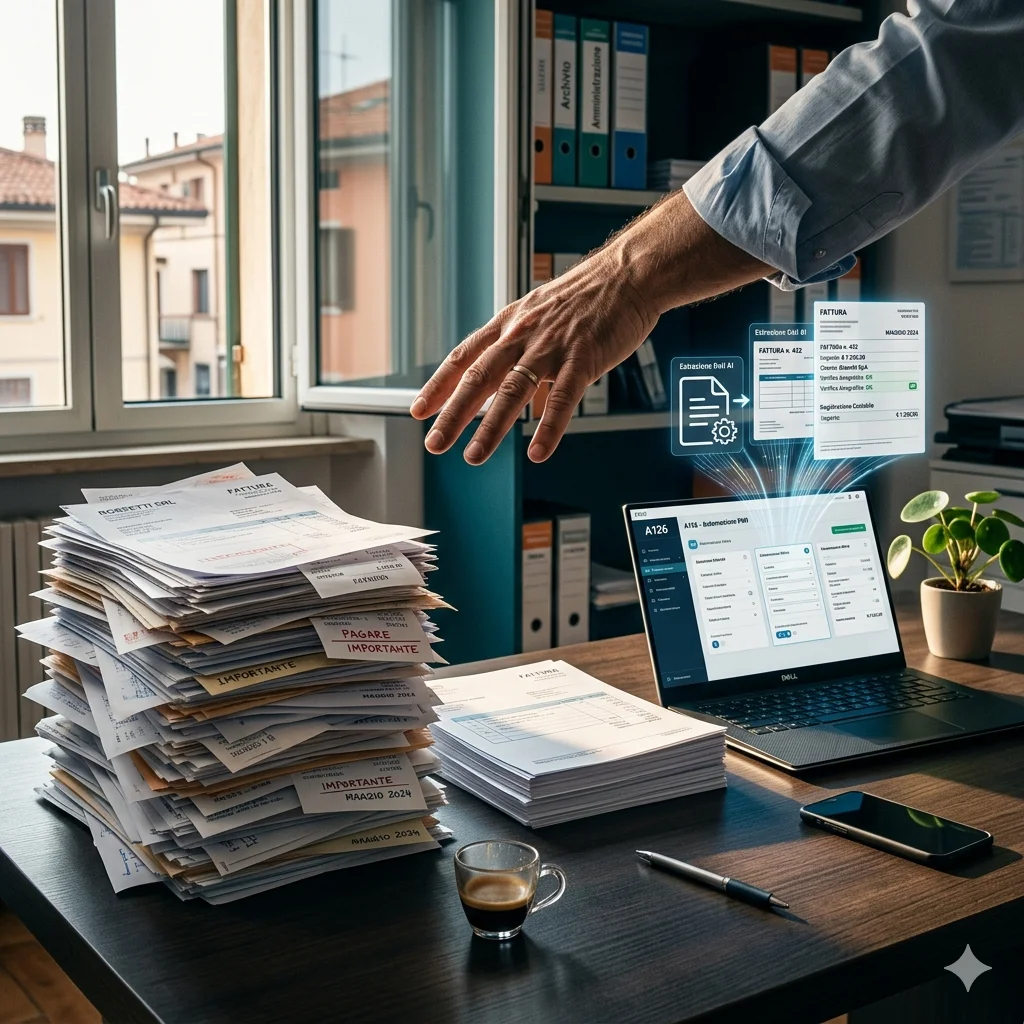
This is probably the use case with the fastest ROI for Italian SMEs. Every company receives invoices, delivery notes, orders and contracts in different formats: PDFs, email attachments, paper scans, poorly structured Excel files. The manual work consists of opening each document, reading the relevant data, and copying it by hand into the management system.
Intelligent Document Processing systems solve this by automating the entire cycle. The document is recognised, classified, the data extracted (invoice number, amount, date, supplier, line items), and entered directly into the management system without human intervention. Human oversight shifts from the mechanical part of data entry to the checking of exceptions: only the documents the system cannot process with confidence are flagged for review.
The numbers are significant. A manufacturing SME handling 300 invoices a month, starting from an average manual processing cost of 8.50 euros per invoice, spends around 2,550 euros a month on administrative time alone. With an automatic extraction system the cost drops to less than 250 euros a month. The system typically costs between 3,000 and 8,000 euros to set up, with modest monthly fees, and pays for itself in a few months.
3. Automatic report generation
Internal reporting is one of those jobs everyone hates and no one does willingly. The sales manager who has to prepare the week's report on Thursday evening, the owner who builds the summary for Monday's meeting on a Sunday, the administration team that every month pulls together data from three different systems for the management accounts.
AI report generation tools automate this process by connecting to the source systems (management software, CRM, e-commerce, booking systems) and producing pre-formatted reports with comments written in natural language. The system does not merely report numbers: it identifies anomalies, highlights trends, flags KPIs that are out of bounds. What used to take three hours of work a week becomes a report that arrives ready in the inbox on Monday morning.
The key point is that these systems do not replace the strategic analysis of the owner or manager. They replace the mechanical preparation of the report, leaving the manager the time to read it and make decisions. It is an important difference: the AI does the work of copying and formatting, the manager does the work of interpreting.
4. Automatic handling of recurring internal requests
Every company has a constant flow of repetitive internal requests: the employee asking to book holiday, the salesperson who wants to know the status of an order, the warehouse worker asking for information about a customer, the new hire looking for company documents. These requests are usually handled by email or WhatsApp, taking up the time of whoever has to answer.
An internal AI assistant, trained on company processes and documents, handles this flow automatically. Employees ask in natural language, the assistant responds with the correct information, drawing it from the company systems. There is no longer any need to consult manuals, search through old emails, or ask the colleague who knows where things are. Company knowledge becomes accessible in real time to everyone.
For SMEs with 20-50 employees this single change can eliminate several hours a day of interruptions and repeated questions, freeing the most experienced people from the inappropriate role of internal "information desk".
How to choose the first process to automate
The most frequent question from an SME entrepreneur faced with AI automation is: where do I start? The correct answer is not "buy this tool", but "look at where you lose the most time". There are three practical criteria for choosing the first process.
The first is volume. Automation makes sense where the numbers are significant: 50 invoices a month do not justify an investment, 300 do. The same applies to email, customer requests, documents to process. The higher the volume, the faster the return.
The second is repetitiveness. The processes that can be automated are those with clear, recurring rules. An invoice always has the same fields, a sales email always has the same structure, a weekly report always follows the same logic. Processes that change every time, that require case-by-case judgement, are much harder to automate and rarely worthwhile.
The third is the availability of digital data. AI works well on data that already exists in digital format. If invoices arrive on paper and are badly scanned, if customer requests are only made by phone, if reports start from Excel spreadsheets written by four different people with different structures, the first job is to put the data in order. This step is often the real bottleneck: recent European studies show that over 70% of an AI project's time is spent preparing and cleaning the data.
At A126 Web Technologies we tackle these three steps together with Italian SMEs before even talking about specific tools. We analyse the current processes, identify where automation produces concrete results, and build the integrations with the management system and existing systems. This approach makes the difference between an investment that pays for itself and one that becomes a dead cost.
What to expect and what not to expect
AI automation in SMEs is not a magic formula. It does not replace people outright, it does not solve organisational problems that existed before AI, and it does not work if the upstream processes are chaotic. What it does, when implemented well, is reduce repetitive manual work by 30-60% in the automated processes and free up staff time for higher-value activities.
The figure worth remembering is that 92% of companies that adopt generative AI in their processes report a positive ROI. This is not an anomalous figure: it is the natural consequence of the fact that many business processes are enormously inefficient compared with what current tools make possible.
The real obstacle for most Italian SMEs is not cost or technical complexity. It is the lack of a clear starting point. Buying a generic tool without mapping the processes almost always leads to disappointment. Starting from the process that burns the most hours, choosing the right tool for that scale, integrating it with the existing systems: this is the sequence that works.
Conclusion
AI automation is not the future of Italian SMEs: it is the present of a small minority of companies that are moving ahead of the rest. The 37-percentage-point gap between large enterprises and Italian SMEs on AI adoption represents a window of opportunity that will not stay open for long. The companies automating email, invoices, reports and internal requests today are building an operational advantage that will become difficult to catch up with.
The critical point is not the choice of tool, but mapping the right process to automate first. Volume, repetitiveness, available digital data: these are the criteria for getting the first investment right.
If you are considering where to start with AI automation in your internal processes, or if you have already tried without getting the expected results, get in touch for a free consultation: together we will analyse your current workflows, identify the process with the best potential return, and build a realistic automation path, integrated with your management system and your existing systems.
A126 Web Technologies — Tailored digital solutions for Italian SMEs.