AI and Document Management: How to Turn Contracts, Invoices and Archives into an Intelligent System
An average employee spends up to 40% of their time managing documents. The Italian document management market is worth 2.3 billion euros and AI is moving beyond old-style OCR: how to go from chaotic PDFs to an archive that understands what it holds.
The invisible tax every company pays
There is a cost that appears in no balance sheet yet that every business, every professional firm and every office pays every single day: the time spent looking for documents. A contract saved under an incomprehensible name on a shared server, an invoice that was "definitely in that folder", a delivery note the customer needs and that no one can find. According to analyses by PricewaterhouseCoopers, an average employee ends up spending between 30% and 40% of their time managing documents: searching for them, filing them, photocopying them or recreating them when they turn out to be untraceable. It is a hidden tax on productivity that weighs on every department.
The problem is not the lack of tools for storing documents, but the fact that storing is not enough. Converting paper into PDFs and piling the files into digital folders simply moves the disorder from a physical cabinet to a virtual one. The documents remain opaque: the system knows there is a file called "scan_047.pdf", but it does not know that it is a contract, who signed it, when it expires or how much it is worth. This is where artificial intelligence changes the rules of the game, turning a mute archive into a system that understands what it contains.
The topic is far from niche. According to the Digital B2B Observatory at the Politecnico di Milano, in 2025 the Italian digital document management market reached 2.3 billion euros, growing 13% on the previous year. And it no longer concerns only large companies: document digitisation has become a concrete field for SMEs, professional firms and businesses with warehousing and logistics as well. This article explains how it really works, what technologies lie beneath it and how to set up a sensible workflow.
The problem of documentary "dark data"
Before talking about solutions, it is worth understanding the problem better, because it has a precise name: dark data. These are the data an organisation collects, stores and then forgets. Emails from years ago, backups never reopened, contracts scanned and buried, attachments no one has read since. On the surface they are inert mass, but they carry a double cost: they take up space and resources, and above all they hide valuable information the company owns but cannot use.
The paradox is obvious. Within those documents lies almost everything a business needs in order to run better: the terms negotiated with suppliers, contract deadlines, customers' payment terms, the history of supplies. But as long as they remain PDFs unreadable by a machine, that value is frozen. Worse still: forgotten data is also the riskiest, because it often contains personal or sensitive information kept without oversight, a serious problem when it comes to complying with the GDPR.
To this is added the cost of error. Manual management has an inherently high error rate: a document filed in the wrong place is, to all intents and purposes, a lost document, and recreating it costs time and money. Various studies estimate the cost of reconstructing a single lost document at around a hundred euros in working hours and checks. Multiplied by the documents an SME loses in a year, the bill becomes serious.
From old OCR to understanding the content
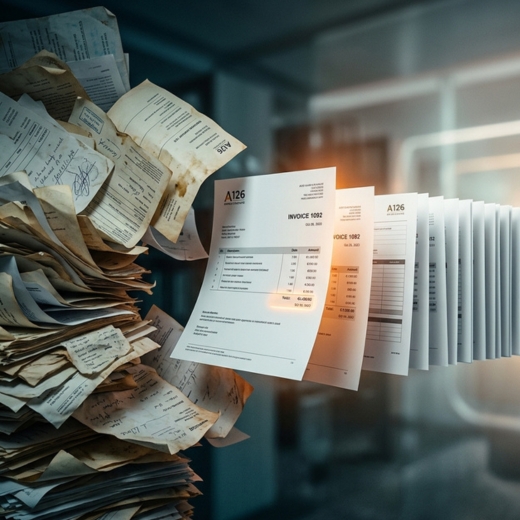
For years the reference technology for digitising documents was OCR, optical character recognition: a tool that turns the image of a text into searchable digital text. It is useful, but it has a clear limit: it converts characters without understanding their meaning. Traditional OCR reads the string "Total amount: 12,450.00" but does not know it is the total of an invoice; it works well only with documents in a fixed, predictable format, and it breaks down as soon as the layout changes or the scan is of poor quality.
The leap of recent years is called Intelligent Document Processing, or IDP: a family of AI-based technologies that do not merely read, but interpret. An IDP system understands that "Tizio S.p.A." is the supplier, that "15/03/2026" is the payment due date and that a given number is the taxable amount. The difference is substantial: you move from reading characters to understanding the document. It is no coincidence that the market is shifting quickly in this direction. According to the 2025 Market Momentum Index by AIIM and Deep Analysis, 66% of companies planning new document projects intend to replace traditional OCR systems with solutions based on artificial intelligence.
What makes this leap possible are above all the large language models, the same ones that power conversational assistants. Applied to documents, they can handle natural language, distinguish between similar terms such as "invoice number" and "reference code", and derive meaningful data even from unstructured texts such as emails, contracts or correspondence, where no fixed schema exists. The most advanced platforms can handle hundreds of different document formats, turning heterogeneous documents into structured data ready to be used by management systems.
How an intelligent document workflow works
It is worth lifting the hood and seeing how a system of this kind is concretely structured, because it helps to understand what to expect and what to ask of a supplier. An IDP platform typically works in five stages, which together form a genuine assembly line for the document.
The first is acquisition and pre-processing: documents enter the system from different sources, scanners, emails, shared folders, portals, and are normalised and cleaned up, enhancing low-quality images so that the later stages work better. The second is classification: the system automatically recognises what kind of document it is, whether an invoice, a contract, an order or a delivery note, and routes it to the correct treatment, even when the files arrive in a mixed, disordered flow.
The third stage is the heart of the system, data extraction: the AI identifies the relevant information, dates, amounts, names, order numbers, and turns it into structured data. The fourth is validation: the extracted data is checked and compared with other sources. A typical example is an SME's accounts payable cycle, in which an invoice received is automatically compared with the purchase order recorded in the management software, and any discrepancies are flagged to a manager instead of going unnoticed. The fifth and final stage is integration: the validated data flows into the company systems, management software, CRM, accounting, typically through automatic connections, closing the loop without manual re-entry.
There is one distinctly Italian detail worth knowing. The electronic invoice in XML format that passes through the Exchange System (Sistema di Interscambio) is already structured at source: a good system processes it directly, with no need for OCR. This means that for many Italian SMEs an important slice of the document work, the part concerning invoices, starts out ahead, and AI can concentrate on the rest: contracts, correspondence, delivery notes, forms.
Three contexts, three applications
The subject touches very different realities, and it is worth seeing how the same approach plays out in concrete situations, without claiming they are universal recipes.
A generic SME swamped with invoices, contracts and PDFs finds its first benefit in the accounts payable cycle: incoming invoices are classified, the data extracted and compared with orders, and whatever is compliant is recorded automatically, while only the exceptions land on a person's desk. It is the point where the time saved shows up immediately.
A professional firm, such as an accountant's or a lawyer's, works with enormous volumes of heterogeneous documents for many clients. Here the value lies in automatic classification and semantic search: being able to ask "find me all the contracts with that clause" and get an answer in seconds, instead of opening folders by hand, changes the way people work. The search is no longer based on the file name, but on its actual content.
A company with warehousing and logistics lives with waybills, delivery notes and orders arriving in different formats from different suppliers. An intelligent system extracts the key data from each of them even when the layout changes, reconciles them with the orders and feeds the management software, reducing manual entry and errors along the chain. It is exactly the kind of variable document on which traditional OCR failed and on which AI now works.
What you really need to get started
The risk, faced with these technologies, is to think they require enormous projects and large-enterprise budgets. That is not the case, provided the subject is approached methodically. The first principle is to start from a specific, painful process, not from the entire archive. Accounts payable, managing contracts nearing expiry, filing client case files: you choose the area where the disorder costs the most and you begin there, measuring the time saved. A successful pilot on a single workflow is the best way to build trust and understand what works.
The second principle concerns integration. A document system that lives in isolation is of little use: the value emerges when it communicates with the tools the company already uses, from the management software to the CRM to the digital signature. It is the difference between a tidy archive and an automated process. For this reason, more than any single technology, what matters is the overall architecture: how the pieces talk to one another.
The third principle is data quality and governance. AI is powerful but not magical: if the source data is chaotic, even the best system will produce mediocre results. You need to establish shared classification rules, define who can access what, and decide how long to keep each type of document, both for efficiency and for compliance. On this last point the regulatory framework also weighs: the AgID Guidelines impose precise deadlines on organisations for document management and retention, and the new European regulation on artificial intelligence (AI Act) adds requirements on transparency and data processing that are best considered from the outset, especially when handling documents containing personal data.
One fixed point remains, valid here as in every application of AI: the machine proposes, the person checks. At the critical junctures, a discrepancy on an invoice, an unusual clause in a contract, the final word rests with those who know the company. The aim is not to remove people from the process, but to take them out of repetitive work and return them to judgement.
The concrete return
The benefits of an intelligent document system are among the most measurable in the field of automation, and it is one of the reasons this area is growing so fast. Various sector analyses, based on the Digital B2B Observatory's data, estimate that fully digitising document processes can cut operating times by around a third and generate savings of up to a hundred euros per single order cycle, thanks to the reduction of manual errors and search times. These are figures that vary greatly from company to company and should be taken as orders of magnitude, not as promises, but the direction is clear: less time wasted, fewer errors, fewer lost documents.
Beyond the numbers, the most lasting advantage is another. An archive that understands what it contains stops being a burden and becomes a resource: deadlines no longer slip by, information is found in seconds instead of hours, and the data buried in documents becomes available again for better decisions. It is the shift from being subject to your own documents to putting them to work.
At A126 we help SMEs, professional firms and companies make exactly this shift: we analyse the existing document workflows, identify the process from which it makes sense to start and build a system that integrates with the tools already in use, without upending the way people work and holding efficiency and compliance together. If you want to understand where to begin putting your documents in order, contact us for a free consultation: we start from what you already have and identify the first workflow to make intelligent.
A126 Corporate Advisors — We give meaning to the documents your company already owns.