AI and Data Analysis for SMEs: Making Better Decisions Without Hiring a Data Team
The Italian data market is growing 20% a year and has surpassed 4 billion euros, yet 60% of SMEs admit they cannot exploit the data they already hold. AI bridges the gap without a data analyst and without enterprise software.
The treasure no one opens
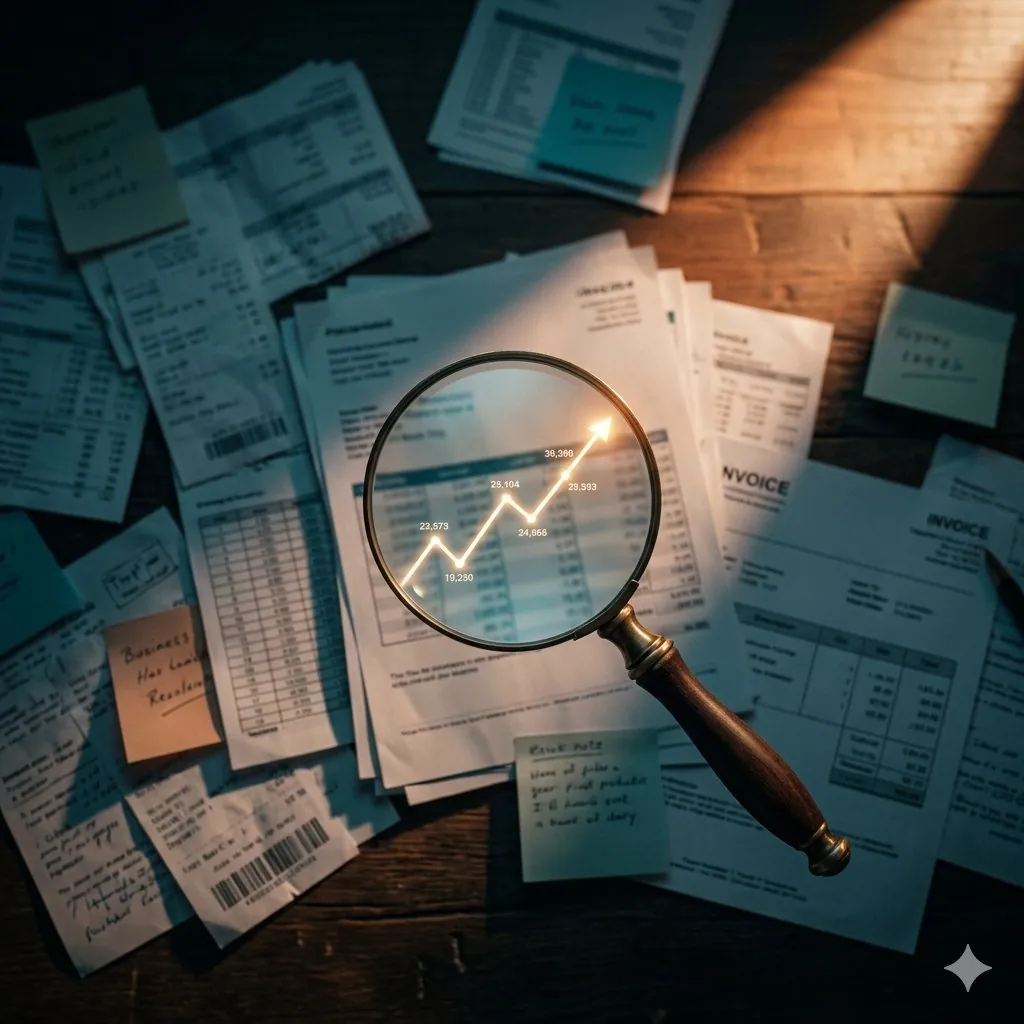
Almost every small and medium-sized Italian business is sitting on a goldmine of data without realising it. There is the management software that records every invoice, the CRM with the history of every customer, the website analytics that count visits and where they come from, the social media statistics, the warehouse spreadsheet, the support emails. Taken individually, each of these sources tells a fragment of the story. Put together, they would tell a great deal: which customers are about to leave, which product is genuinely profitable and which only appears to be, in which month it makes sense to push a promotion. The problem is that almost no one puts them together.
The national picture is clear. According to the Big Data & Business Analytics Observatory at the Politecnico di Milano, the Italian data market is growing at a rate of roughly 20% a year and has surpassed 4 billion euros. Yet, beneath this surge, small businesses remain largely excluded: a sector analysis estimates that around 60% of SMEs admit to critical gaps in their ability to work with their own data, and that nearly 30% have no dedicated role at all. The result is a paradox that anyone running a company will recognise: you are drowning in information and, at the same time, short of answers.
For years the explanation was simple: analysing data requires skills and tools that an SME cannot afford. An analyst is expensive, business intelligence platforms are designed for large corporations, and there is never any time to learn. Generative artificial intelligence has changed this equation, and it is worth understanding how, without falling into either scepticism or miraculous promises.
Why SMEs still decide "by gut feeling"
There is one figure that captures the distance between awareness and practice rather well. Research by Harvard Business School found that 92% of executives consider data extremely important, yet 76% of employees say they do not feel confident using it in practice. This is precisely the space in which most decisions in small businesses live: everyone knows the data would matter, but when the moment to decide arrives, they fall back on intuition, on experience, on "that's how it went last year".
The intuition of an experienced entrepreneur is not to be dismissed, quite the opposite. The problem is that on its own it misses certain things. It does not notice that an important customer has cut orders by 30% over the last four months, because that decline is diluted among hundreds of other transactions. It does not spot that a product with strong revenue actually has a low margin once returns and shipping costs are subtracted. It does not connect a spike in support requests during a certain period to a poorly calibrated advertising campaign. These are patterns that emerge only by cross-referencing sources, and that is exactly what a single person, working alone and by hand, systematically misses.
The consequences are not theoretical. An SME that decides without data risks over-stocking its warehouse and tying up cash, mispricing a product and eroding its margins, investing in channels that bring no customers. International research is cautious but consistent in pointing to a measurable advantage for those who adopt a data-driven approach: studies by the MIT Sloan School of Management indicate that companies using data systematically record around 5-6% higher productivity and profitability than their direct competitors. It is not the doubling promised by some advertising, but it is a real advantage that compounds over time.
What AI can actually do with an SME's data
It is worth being concrete about what "using AI to analyse data" means, because the phrase is vague and lends itself to misunderstanding. It is not about handing decisions over to an algorithm, but about using AI to do, in a few minutes, three things that previously required technical skills or time no one had.
The first is to consolidate different sources. An SME's data is almost always fragmented: revenue sits in the management software, contacts in the CRM, traffic in the analytics, online sales in the e-commerce platform. AI tools can read an exported spreadsheet, interpret its columns, clean up inconsistent values and relate them to another table, even when the formats do not match. This is the most tedious and most underrated part of data analysis, and it has historically absorbed the largest share of it. Automating it frees up time and removes the main barrier to entry.
The second is to identify patterns. By uploading sales history, you can ask the AI to pinpoint the real seasonality, not the perceived one: in which weeks demand genuinely rises, which products sell in pairs, which customers are showing signs of churn because the frequency of their orders is falling. These are questions that once required an analyst and that today can be posed in plain language, yielding a first answer within minutes. The answer must be verified, but as a starting point it drastically shortens the process.
The third is to generate readable reports. A table of numbers is one thing; a summary that says what happened, why, and what is worth focusing on is quite another. AI is particularly effective at turning raw data into a summary that even someone with no grounding in statistics can understand, in language suited to those who have to decide rather than those who have to calculate. For an SME without a dedicated department, this means having a clear snapshot every month without having to build it by hand.
There is then a fourth function, more recent and more delicate, which observers call predictive analytics or "decision intelligence": using historical data not only to explain the past, but to estimate what might happen. Sales forecasts, scenario simulations, demand estimates. Here caution is essential, because a forecast is only a hypothesis based on what has already happened, and it must be treated as such. But even a rough estimate, if honest about its limits, is often better than no estimate at all.
Three situations where something changes
To make the point concrete, it is worth imagining three situations typical of an Italian SME, not as universal recipes but as examples of questions that data can answer.
A small trading company with a few hundred active customers struggles to work out who it is about to lose. By cross-referencing order history, AI can highlight the customers whose purchase frequency has dropped abnormally compared with their usual behaviour, flagging in advance those who deserve a phone call before they stop buying altogether. It is information that goes unnoticed in the daily flow of invoices, and that instead makes it possible to act while there is still time.
A shop with both physical and online sales wants to understand which product is really worth promoting. The best-seller is not always the most profitable: once discounts, returns and shipping costs are subtracted, the picture can be turned on its head. By consolidating sales data with margin data, the analysis shows where the real profit lies and where, instead, a lot of work earns little, steering promotions towards what counts.
A service business investing in online advertising has no idea which channels are working. By relating advertising spend, website visits and the contact requests that actually came in, it becomes possible to distinguish the channels that bring customers from those that burn budget. These are all questions that an AI-guided analysis can answer within the timeframes and with the skills that a small business can reach, where previously dedicated consultancy was needed.
How to start without upending the business
The wrong way to tackle this shift is to buy a tool and hope it solves everything. The right way is to start from a concrete business question. Not "I want to do data analysis", but "why is that customer buying less?", "which product is really worth pushing?", "when does it make sense to launch the promotion?". It is the question that drives which data you need, not the other way around.
The first practical step is to understand which data you already have and where it is. Almost always there is more than you think: a management system, a social media account, the website analytics and the customer list are enough to begin. You do not need new infrastructure; you need to gather what already exists in an exportable format, typically a spreadsheet. The second step is to choose a single starting question and work on that, instead of trying to analyse everything at once. A single case handled well teaches the method and produces a visible result, which is the best way to win over a sceptical team.
The third step is data quality. AI is powerful but it does not work miracles: if the starting data is incomplete, duplicated or riddled with errors, even the best analysis will produce wrong conclusions. The old principle holds, that garbage data yields garbage answers. Devoting a little time to tidying up the sources, even with the help of AI itself, is an investment that pays off on every subsequent analysis.
One fixed point runs through all of this: AI suggests, the person decides. The very researchers at the Politecnico's Observatory reaffirm this, urging that artificial intelligence be regarded as a means and not an end, keeping the culture of decision-making at the centre. The tool shortens the distance between data and information, but the judgement of what to do with that information, drawing on knowledge of one's own market, customers and sector, remains human. This is good news, because it means the competitive advantage does not lie in having AI, which is now within everyone's reach, but in knowing how to use it with judgement.
A gap set to widen
There is one final consideration that makes the topic more urgent than it may seem. The advantage of those who work well with data is not static: it compounds. A company that learns to read its own numbers makes slightly better decisions every month, and these small advantages add up over time, while those who keep deciding by gut feeling stand still. Analysts describe it as a gap that widens year after year between companies that master their own data and companies that ignore it.
For an SME this means that the moment to start is not when there will be a budget for a data analyst or an expensive platform, because for many small businesses that moment will never arrive. The moment is now, with the accessible tools that already exist and the data you already have. You do not need to become an algorithm-driven company: it is enough to stop throwing away the information that your daily activity generates on its own.
At A126 we help small and medium-sized businesses make exactly this shift: understanding which data they already have, identifying the right questions to answer and building a simple, sustainable method for turning scattered numbers into concrete decisions, without expensive infrastructure and without upending the way they work. The goal is not technology for its own sake, but better and faster decisions. If you want to understand where to start with your company's data, contact us for a free consultation: together we will analyse what you already have and which first question is worth tackling.
A126 Corporate Advisors — We turn SMEs' data into concrete decisions.